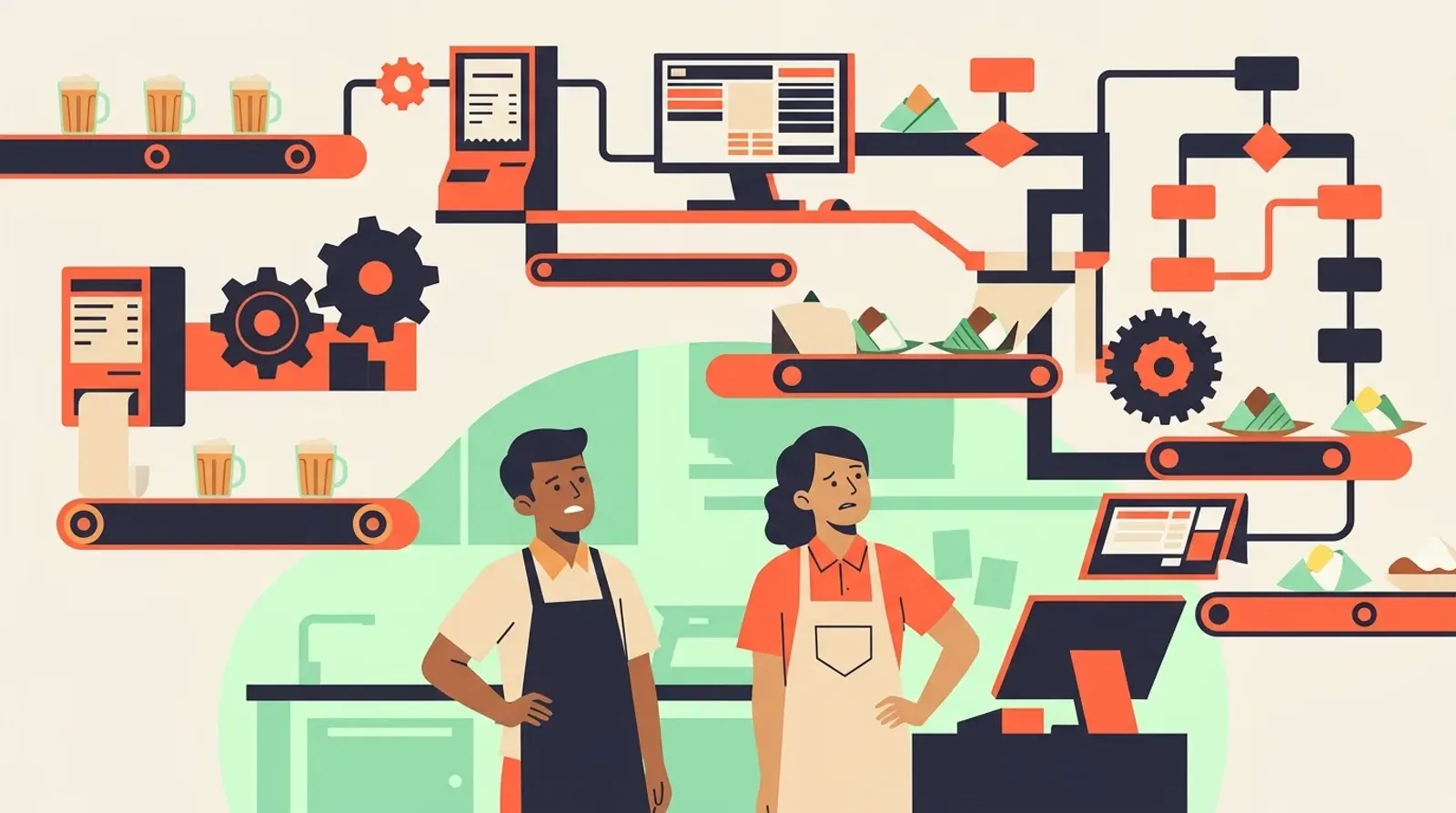
From jazz musicians in 1915 to same-day pay apps today — the full history of the gig economy and why the system was never built for workers.
History of the Gig Economy: Built to Keep You Waiting
The System Was Never Built for You
You finished the shift. You did the work. But the money? That arrives later — maybe days from now, maybe next week, depending on which platform holds it.
Meanwhile, somewhere between your labour and your pay, an intermediary took its cut. Quietly. Automatically. Before you saw a single ringgit.
This is not a bug in the gig economy. It is the design.
The Middleman Always Gets Paid First
For as long as flexible work has existed, the people organising it have found ways to profit from the gap between when work happens and when workers get paid. That gap is not accidental. It is where the money lives — for everyone except the person who did the job.
Modern platforms refined this into a system. Workers accept low base rates because the volume is there. Platforms skim a significant share from every transaction. Operators pay premium fees for convenience they often do not get. And when something goes wrong — a no-show, a last-minute cancellation, a shift that vanishes — the worker and the operator absorb the damage while the platform keeps its margin.
History Is the Map
Understanding how this system was built is not an academic exercise. It is a practical one.
Every frustration you have felt — waiting on payment, scrambling to fill a shift, being treated as a replaceable unit rather than a skilled person — has a history behind it. That history explains why the old model was built to extract rather than serve.
But history also shows something else: when the infrastructure changes, the power shifts.
You Can Choose Different Tools
The gig economy’s past does not have to be your future. Workers and operators who understand the system can make smarter decisions about which platforms they use, how they protect their time, and what they refuse to accept.
That is what this article is about. Not nostalgia. Not theory. A clear-eyed look at how flexible work became a waiting game — and how tools like FlashJobs are being built to end it.
Same-day pay. Nearby shifts. A two-hour SLA when operators need cover fast.
The system was never built for you. It is time to use one that was.
Where ‘Gig’ Actually Comes From (1900s–1930s)
The word “gig” did not come from a Silicon Valley whiteboard. It came from working musicians in early 20th-century America.
Jazz and blues players used it as shorthand for a single paid performance — one night, one venue, one fee. No contract. No guarantee of tomorrow. You played, you got paid, you moved on. The term stuck because it described something real: work that existed in flashes, not in steady streams.
Flexible Work Is Older Than the Word
Here is what the history books often skip. Multiple-job working is not a modern invention. Historian Tawny Paul’s research on pre-industrial labour shows that ordinary people — craftsmen, labourers, seasonal workers — routinely combined several income sources just to stay afloat. Flexibility was not a lifestyle choice. It was how you survived when no single employer could guarantee your rent.
That context matters. The moment you understand it, the romantic story of the gig economy starts to crack.
The Dust Bowl Made It Undeniable
By the 1930s, the pattern was impossible to ignore. The Dust Bowl displaced hundreds of thousands of farming families across the American Midwest. They moved constantly, picking up short-term agricultural work wherever they could find it — harvesting one crop, then another, then moving again.
These were not entrepreneurs embracing freedom. They were skilled, capable people forced into a system that offered no stability. Flexibility was the only option left.
The Pattern That Never Left
Three things were true in 1930. They are still true today.
- Flexible work fills gaps that permanent employment leaves behind.
- The worker carries the risk.
- The person controlling access to the work captures the reward.
That last point is where the broken middleman system was born — long before apps, algorithms, or platform fees existed.
Understanding this history is not just interesting. It is useful. When you see a staffing agency take a wide cut for doing very little, or a platform that makes you wait days for pay you earned today, you are looking at a structure with roots over a century old.
The enemy was never flexibility itself. The enemy was always the layer in the middle that profited from keeping workers and opportunities apart.
The Corporate Shake-Up That Created the Modern Freelancer (1950s–1980s)
After World War II, stable employment felt like a birthright. Large companies offered long careers, predictable wages, and a clear social contract: show up, work hard, retire with a pension. For roughly two decades, that model held.
Then the architects of “efficiency” got to work.
When Loyalty Became a Liability
Through the 1950s and into the 1960s, management consultants began reframing permanent headcount as a cost problem. The logic was clean on paper: if a task is not core to the business, why own it? Outsource it. Contract it. Make it someone else’s problem.
By the 1970s, economic pressure — inflation, oil shocks, intensifying global competition — gave executives the cover they needed to act on that logic at scale. Downsizing became strategy. Entire departments were stripped out and handed to third-party vendors or converted into contract arrangements.
Skilled workers who had expected a career suddenly found themselves holding a project brief instead of a paycheck.
The Middleman Sees an Opportunity
This is the moment the staffing agency model took root. Companies needed flexible labour but did not want the administrative burden of managing it directly. Agencies stepped in to fill that gap — and immediately inserted themselves as a permanent toll booth between workers and the businesses that needed them.
The arrangement looked like a solution. In practice, it transferred risk downward.
- Companies shed the obligation of benefits, continuity, and job security.
- Workers absorbed that risk in exchange for flexibility they rarely asked for.
- Agencies collected a margin on every hour worked, adding cost without adding value to either side.
The Profit Stayed at the Top
What the history of this period makes clear is that the restructuring was not neutral. Corporations offloaded uncertainty onto individuals while retaining the upside. The freelance or contract worker became a buffer — absorbing volatility so that quarterly results stayed smooth.
That structural logic never changed. It simply moved online.
The staffing agency of the 1980s became the platform of the 2010s. The toll booth got a better interface. The cut stayed.
Understanding this is not about grievance — it is about clarity. When a system consistently extracts value from the people doing the work, that is not an accident. It is the design. And recognising the design is the first step to choosing something built differently.
The Internet Opens the Door — and the Middlemen Rush In (1990s–2000s)
The internet looked like liberation. For the first time, a worker in Petaling Jaya or Penang could connect with an employer without going through an agency. No phone calls to a recruiter. No waiting for a notice board. Just a listing, a reply, a job.
Craigslist launched in 1995 and proved the concept. Millions of workers and hirers found each other directly. The middleman looked finished.
Then the middleman adapted.
Digitising the Problem, Not Solving It
Early freelance platforms arrived in the late 1990s and early 2000s. They promised to modernise hiring. What they actually did was move the agency model online and take a cut from both sides.
The structure was familiar:
- Workers competed in a race to the bottom on price
- Platforms held payment in escrow — releasing it on their schedule, not yours
- Disputes favoured whoever paid more in fees
- Your reputation lived on their platform, not with you
Workers gained reach. They could find more work, faster. But leverage? That stayed with the platform.
The ‘Freedom’ Framing Starts Here
This era introduced language that would define the next two decades. Words like flexibility, autonomy, and be your own boss appeared in platform marketing from the start. The framing was deliberate. It positioned the worker as an entrepreneur, not an employee — which conveniently shifted risk onto the worker and kept the platform clean of obligations.
If the work dried up, that was your problem. If a client ghosted you, the platform shrugged. You were free, after all.
The Dependency Nobody Advertised
Here is what the freedom framing masked: every platform became a gatekeeper. Your income depended on their algorithm, their fee structure, their dispute process. The old staffing agency had a phone number you could argue with. The new digital middleman had a help ticket and a 72-hour response window.
Workers traded one dependency for another — and the new one was harder to see.
This is the pattern that carried forward into the app economy. The technology changed. The power structure did not.
For F&B workers in Malaysia, that same dependency plays out every shift — until infrastructure like FlashJobs puts same-day pay and nearby work back in the worker’s hands, not the platform’s.
The App Economy Explodes — and the Cut Gets Bigger (2009–2015)
Desperation, Not Design
The 2008 global financial crisis did not create the gig economy. It supercharged it. Millions of workers lost stable jobs almost overnight. They did not turn to app-based work because it was a better deal. They turned to it because there was nothing else. That distinction matters. The platforms that launched in this window were built to absorb a workforce with no leverage — and they knew it.
The Apps That Defined the Era
Uber launched in 2009. Airbnb followed the same year. TaskRabbit and Postmates arrived shortly after. Each platform made a version of the same promise: flexible work, on your terms, whenever you want it.
The reality was more complicated.
- Platform commissions were quietly normalised. Workers accepted the cut because the alternative was no income at all.
- Payment cycles stretched from same-day to weekly to bi-weekly. Workers absorbed the wait.
- The term “gig economy” entered mainstream business vocabulary around 2009 — framing irregular, unprotected work as a lifestyle choice rather than a structural condition.
The Middleman Gets a New Name
What changed between the old staffing agency model and these new apps was mostly branding. The agency became an algorithm. The phone call became a notification. The commission became a “service fee.” The worker was still the last to get paid and the first to absorb the risk.
By 2015, the model was global, normalised, and largely unquestioned. Workers accepted payment delays as a feature of flexibility. Operators accepted unreliable fulfilment as the cost of on-demand access. Both sides had simply run out of alternatives.
The Pattern Holds
This is the history the gig economy does not advertise. The app era did not fix the broken middleman system. It scaled it. Workers who needed income urgently were handed platforms that made them wait — for shifts, for confirmation, for pay.
That pattern is exactly what FlashJobs was built to break. Same-day pay is not a perk. It is a direct answer to a structural failure that has been compounding since 2009.
What the History Actually Reveals: Workers Always Paid the Price
Look across every era of gig work — jazz musicians booking through agents, freelancers placed by temp agencies, drivers dispatched by apps — and one pattern holds. The worker carries the risk. The intermediary collects the reward.
That is not an accident. It is the architecture.
Risk Flows Downhill
Each time a new layer of technology arrived, it was sold as liberation. In practice, it restructured the same deal: workers absorbed income uncertainty, schedule volatility, and zero benefits, while platforms and agencies locked in their percentage before a single shift was worked.
Payment delays were not oversights. Percentage cuts were not temporary. The absence of worker protections was not an oversight waiting to be corrected. These were design choices that compounded across decades.
The System Is Being Challenged
Workers and courts are pushing back — and winning.
- California AB5 (2019) tightened the legal test for classifying workers as independent contractors, forcing platforms to rethink how they structured their entire workforce model.
- UK Supreme Court, Uber BV v Aslam (2021) ruled that Uber drivers were “workers” under UK employment law, entitling them to minimum wage and holiday pay.
These are not isolated cases. They signal that the legal foundations of the intermediary model are under serious, sustained pressure.
Workers Know What They Are Now
The most important shift is awareness. Workers today understand they are not the customer of these platforms. They are the product — the supply that makes the platform valuable to buyers. That clarity changes how people choose where to work and what they accept.
The Broken Middleman Is the Enemy
The old staffing model — slow, extractive, indifferent — is the villain here. It made workers wait days for pay and left operators stranded when a no-show hit during a Friday dinner rush.
FlashJobs was built as a direct response to that failure. It connects businesses with nearby workers for short-term jobs in Malaysia. Businesses pay workers directly when each job ends, and FlashJobs takes no cut from worker pay.
The history of the gig economy is a story of deferred promises. The next chapter does not have to repeat it.
The F&B Gig Worker in Malaysia: Same History, Same Trap
The history is long. The problem, for F&B shift workers in Malaysia, is immediate.
You finish a double shift at a restaurant in Cheras. You covered for a no-show. You did the work. Then you wait — three days, sometimes two weeks — for wages you already earned. The money is yours. The timing is not.
This is not bad luck. It is the same structural pattern that has defined gig work for decades: a middleman sits between your labour and your pay, and the middleman controls the clock.
The Agency Cut You Never Agreed To
Traditional staffing agencies in Malaysia’s F&B sector were never designed around the worker. They were designed around the contract. An agency supplies bodies to a restaurant, takes its cut, and releases payment on its own schedule. The worker carries the financial risk. The agency carries the margin.
You do not get to negotiate that timing. You rarely even see the breakdown. You just wait.
The No-Show Crisis Hits Both Sides
Operators face the same broken system from the other end. A kitchen hand calls in sick at 10 a.m. The lunch rush starts at noon. A traditional agency cannot move fast enough. By the time a replacement arrives — if one arrives — the damage is done.
The middleman failed the operator and left the worker without consistent access to shifts. Everyone loses except the system itself.
Built to Break the Pattern
FlashJobs was built specifically for this moment — on both sides of the problem.
For operators, a confirmed replacement in around 90 minutes, with a two-hour SLA that makes emergency staffing actually reliable.
For workers, the difference is structural:
- Same-day pay — wages released after your shift, not after someone else’s paperwork cycle
- Nearby shifts — work that fits your location, not a two-hour commute for a four-hour shift
- No wage skimming — the cut does not come out of what you earn
This is what emergency staffing infrastructure looks like when it is built for the worker, not the middleman. Not a platform that makes you disposable. Not an agency that holds your money as leverage.
If you are tired of being the last person paid for work you already did, start at flashjobsapp.com.
The trap has a history. Getting out of it starts now.
Where the Gig Economy Is Heading — and What Workers Can Demand Now
The broken system did not happen by accident. It was built layer by layer — each layer adding a new middleman, a new cut, a new reason to make you wait. But the conditions that allowed that system to thrive are changing fast.
Regulation Is Catching Up
Governments around the world are tightening worker classification rules. The old trick of calling every worker “independent” to avoid paying fairly is under serious legal pressure in the EU, the UK, and parts of Southeast Asia. Policymakers are asking harder questions about who carries the real risk in gig arrangements — and the answers are not flattering to the old platforms.
This matters. When the legal cost of exploiting classification loopholes rises, platforms are forced to compete on something real: how well they actually serve the people doing the work.
The Delay Is a Choice, Not a Limitation
Here is the honest truth that the history of the gig economy reveals: the technology to match a worker to a shift in minutes has existed for years. The wait was never a technical problem. It was a business model. Slow matching, held payments, and opaque fees all served the platform — not you.
That choice can be reversed. Infrastructure built around the worker looks different. It fills a shift fast. It pays the same day. It puts nearby work in front of you without making you chase it.
What You Can Demand Right Now
You do not have to accept the old terms. Ask these questions before you commit to any platform:
- When do I get paid? Same-day pay is possible. Anything longer is a policy decision, not a technical one.
- How far do I have to travel? Nearby work is not a bonus feature. It is basic respect for your time.
- Who is actually in my corner when a shift goes wrong?
The Future Belongs to Infrastructure That Serves Workers First
FlashJobs was built as emergency staffing infrastructure — not another layer of middlemen. For F&B workers in Malaysia, that means same-day pay, nearby shifts, and a two-hour response window that treats your time as valuable.
The history was written against you. The next chapter does not have to be.
Start on your terms at flashjobsapp.com.
Looking for paid jobs near you? FlashJobs connects you with nearby F&B and hospitality jobs — the business pays you directly and FlashJobs takes no cut. Register early.