Shifts with no leave, no EPF, no buffer — and money you wait weeks for. Here's what Malaysian part-timers are owed, and how to get paid the same day.
No Sick Leave, No EPF: The Lack of Benefits Trap
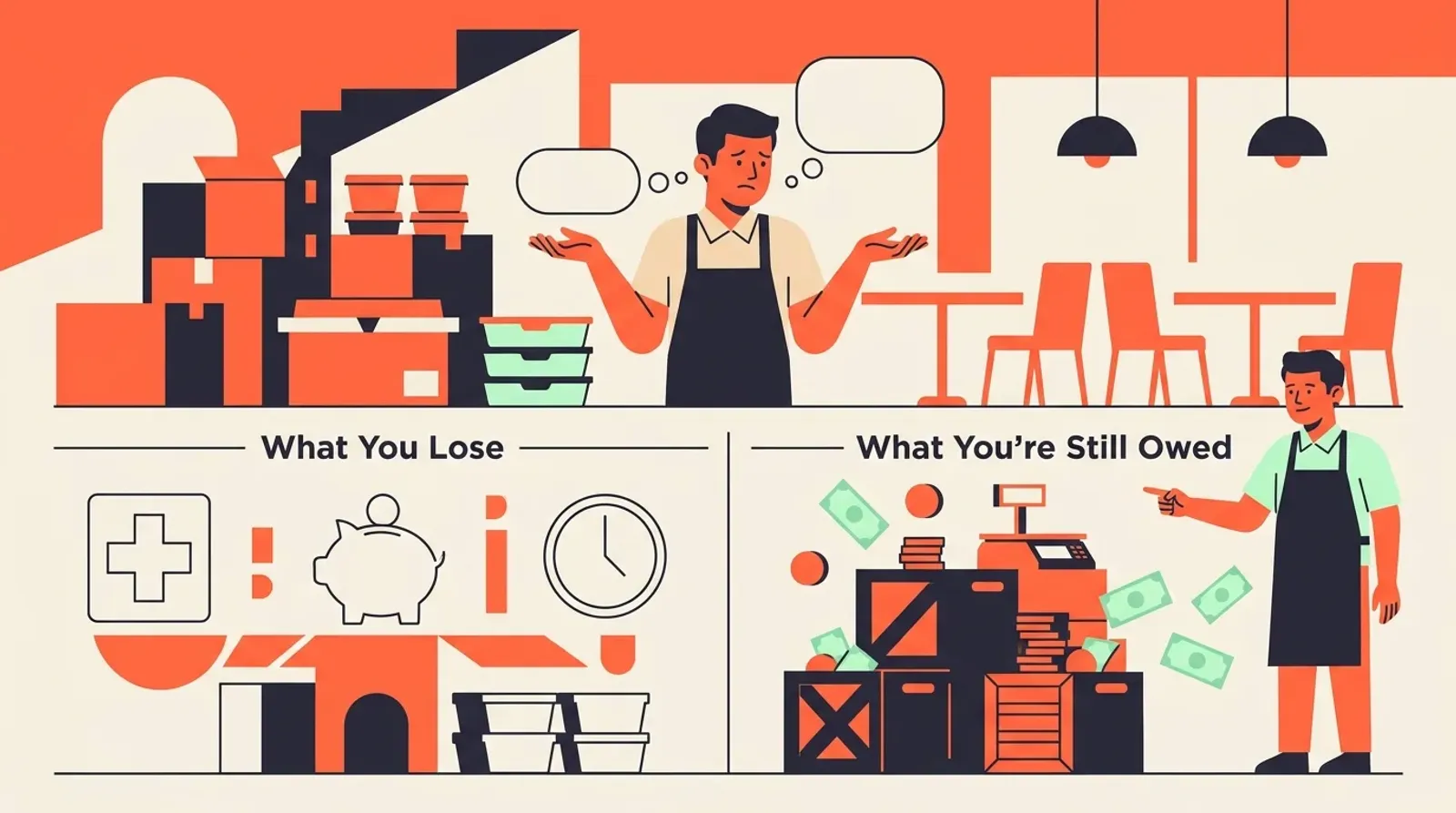
Lack of Benefits, Plainly: What You Lose and What You’re Still Owed
It’s 11pm. The floor server counts the till alone, chairs already stacked, and checks her phone: tomorrow’s shift is cut. No paid leave to fall back on. No medical cover. Nothing behind her.
That’s what “lack of benefits” means in plain terms: no paid annual or sick leave, no medical cover, no retirement contribution, and no income buffer when a shift disappears. But here’s the part the broken middleman system never explains — in Malaysia, not every benefit vanishes just because the work is part-time.
What you’re still owed
If you are engaged as a part-time employee, the Employment (Part-Time Employees) Regulations 2010 provide for pro-rated entitlements such as annual leave, sick leave and paid public holidays, based on the hours you work against a full-timer’s hours. Statutory contributions like EPF and SOCSO also depend on your employment status, not on whether someone calls the shift “casual.”
The real cost
The missing perk isn’t the problem. The problem is that you carry 100% of the risk — cancelled shifts, sick days, a bad month — while the layer sitting between you and the operator carries none.
Two things you can act on this week
- Claim what the law already gives you. Ask which status you’re hired under, in writing.
- Stop letting earned money sit in someone else’s account. On FlashJobs, workers get same-day pay and nearby shifts — your money moves when you do.
Part-Timer or ‘Casual’? The Label Decides What You Can Claim
The word on your roster matters more than the hours you work. If you’re a part-time employee under Malaysia’s Employment (Part-Time Employees) Regulations 2010, you may be entitled to pro-rated paid annual leave, paid sick leave and public holidays. Most workers never hear this from anyone. That silence is the lack of benefits trap — not the law itself.
‘Freelance shift’ is not a legal status
I’ve watched a floor manager at 4pm briefing a new server, handing over an apron and a table map, and never once saying the word “employee”. Vague labels — casual helper, freelance shift, part-time crew — blur a line that decides real money. EPF (KWSP) and SOCSO (PERKESO) contributions are tied to being an employee, not to how many hours you clock. So don’t assume you’re excluded because you only work weekends.
Get it in writing, then verify
Before your first shift, get three things on paper or in a message: your role, your hours, and your pay rate. That single screenshot is your evidence later.
Then check with the source, not a group chat:
- KWSP (EPF) — kwsp.gov.my
- PERKESO (SOCSO) — perkeso.gov.my
- Labour Department (JTKSM) — for employment status questions
Ask directly. Opaque rules only work when nobody asks. FlashJobs exists so the shift itself is clear from the start: the role, the hours, the rate, and same-day pay when the work is done.
The Benefit Nobody Lists: Getting Paid Before Rent Is Due
Sunday, 4pm. A kitchen helper finishes a brunch double, wipes down the pass, peels off the apron, and opens an app on the walk to the bus stop. “Payment processing.” Third week running. The work is done. The money is somewhere else.
That is the trap nobody writes into a job ad. Money you have already earned sits in a system for weeks, and by the time it lands, a cut has been skimmed off the top. You did the shift. Someone else held the cash and took a slice for holding it.
Delayed pay is not paperwork. It’s pressure.
Call it what it is. When pay arrives late:
- You borrow from family or a plan you did not want.
- You pay late fees on rent, phone, or a bike instalment.
- You take any shift at any rate, because waiting is not an option.
That last one is the real damage. Late pay quietly lowers your bargaining power. You stop choosing work and start chasing it.
Treat cash flow as a benefit, not a bonus
You may not get EPF or sick leave on a part-time shift. But cash flow is one benefit you can insist on every single week, and it protects you more often than any annual perk.
FlashJobs was built so the money moves when the shift ends: same-day pay, work near you, no waiting on an opaque queue. See how it works at flashjobsapp.com.
How to Get Paid the Same Day and Keep Your Full Rate
It’s 6:15pm on a Friday. A floor manager is staring at an empty station where the second server should be, already carrying four tables herself. Somewhere fifteen minutes away, a trained server is scrolling, waiting on an approval that hasn’t moved since Tuesday. That gap — not the work, not the wages — is the broken part.
The shift comes to you, not the queue
FlashJobs is emergency staffing infrastructure for F&B in Malaysia. When a venue is suddenly short-handed, the shift is pushed to available workers nearby instead of sitting in a queue waiting for someone to review it. Operators fill an urgent gap in about 90 minutes under a 2-hour SLA. You get same-day pay for nearby work, on hours you choose.
Why urgent shifts pay you better in every sense
Urgent shifts are the ones where your time is genuinely valued. The venue needs hands now, and the rate you agreed is the rate you keep — no cut taken off the top. Same-day pay means the money lands while the week is still in front of you, not after rent is already late.
Two things to do today
- Keep your availability current. Stale availability means nearby urgent shifts route past you.
- Complete your profile. Roles, experience, area. Operators trust a complete profile faster, and speed is the whole point.
Start at flashjobsapp.com and be the person the 6pm rush can actually reach.
Build the Safety Net the Middleman Never Gave You
The broken system’s real trick is making you believe benefits only come attached to a full-time contract. They don’t. You can build your own — and you can start this week.
Two schemes built for people outside standard employment
- EPF i-Saraan — voluntary self-contribution for people without a fixed employer. Check the details straight on the official KWSP site (kwsp.gov.my).
- SOCSO Self-Employment Social Security Scheme — coverage for work-related injury for self-employed and non-standard workers. Verify eligibility on perkeso.gov.my.
Read them yourself. Don’t take a supervisor’s word for what you qualify for.
A three-month buffer, built on payday
Same-day pay changes the maths. Instead of waiting for month-end and hoping something is left, move a fixed slice the moment a shift clears. A floor manager I know does it walking home from an 11pm close — same amount, every time, no decision to make. Three months of rent and food is the target. It takes the panic out of turning down a bad shift.
Keep your own shift log
Date, venue, hours, agreed rate, who signed off. That’s it. It settles pay disputes fast and proves income when you apply for a loan or a rental — the paperwork nobody hands you.
Check your cover
Government clinic charges, a basic medical takaful plan, and one direct question to the venue: am I covered by your insurance while I’m on shift?
Then pick your next shift on your terms at flashjobsapp.com.
Five Questions to Ask Before You Accept Any Shift
You do not need a lawyer to protect yourself. You need five questions, asked before you say yes.
Ask these every time
- When exactly do I get paid — and is anything deducted from my agreed rate? “End of month” and “after processing” are not answers. A date is an answer. If the number on your payslip is smaller than the number you agreed to, ask what the gap is called and who decided it.
- Am I an employee here, and is EPF or SOCSO being contributed for me? Ask plainly. A straight yes or no tells you what you can claim later.
- Who do I contact if the shift is cancelled after I arrive? Get a name and a phone number, not a chat queue. Then ask if travel or partial pay is covered.
- What are the rules for cancellations and no-shows? Know them before you accept, not after.
- Can I see my rate, hours and location in writing? A screenshot is enough.
Red flags — walk away
- Prepaid “training fees” or deposits before your first shift.
- Pay held back pending a rating or review.
- Rules that change after you accept.
- No named person to call when something goes wrong.
That last one is the real villain: a system with nobody home. FlashJobs is built the other way — same-day pay, work near you, and a real operator expecting you. Ask the five questions. Then get on shift at flashjobsapp.com.
Looking for paid shifts near you? FlashJobs matches you to nearby F&B and retail shifts — direct wage pay, zero platform fees. Register early.