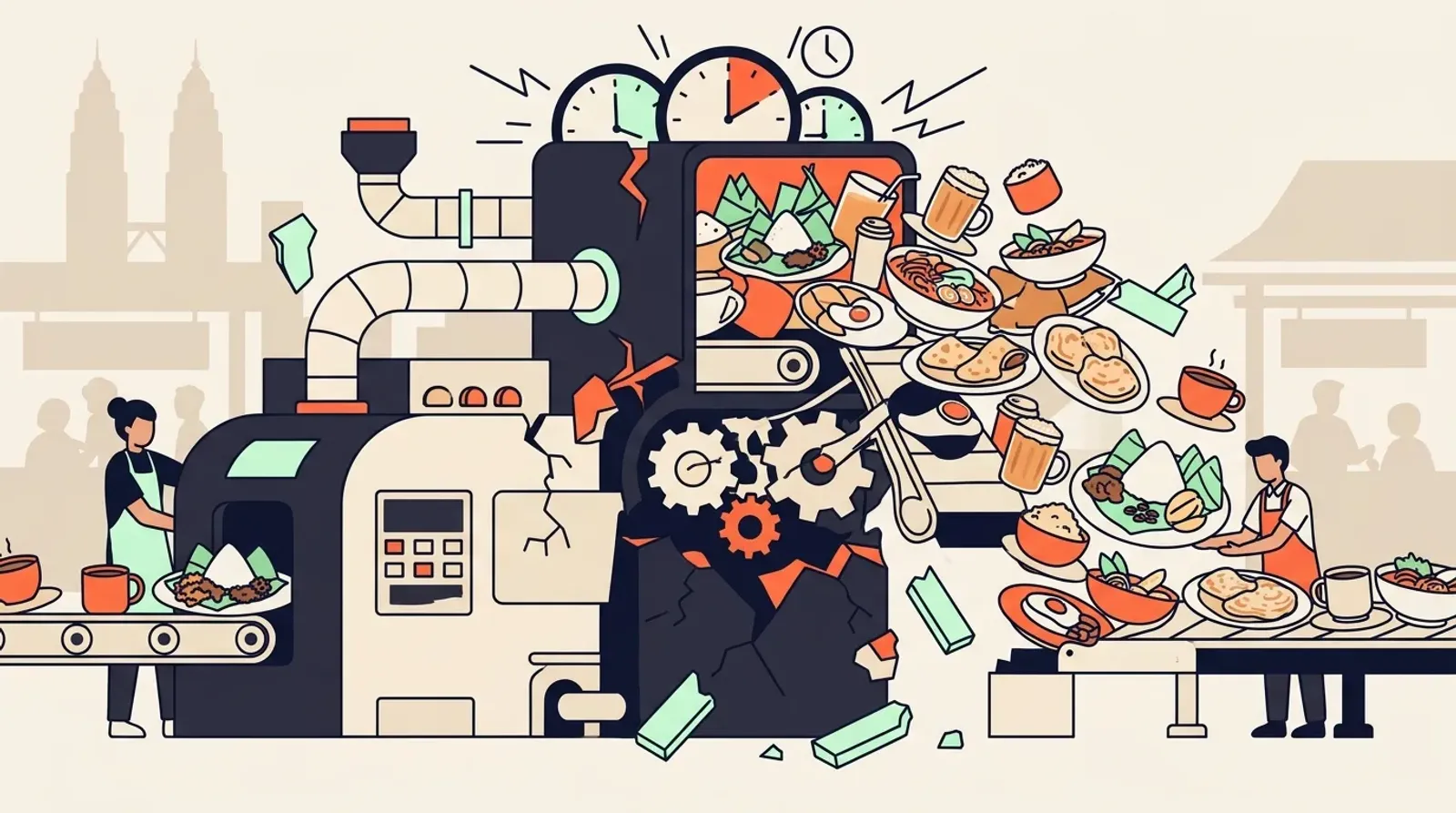
KL restaurants keep losing service to last-minute no-shows. Here's why the staffing system is built to fail you — and how operators fight back.
Why KL Restaurants Can’t Fill Last-Minute F&B Shifts
The System Was Never Built for 6pm on a Friday
You have a full house booked in two hours. One server just called in sick. Your group chat is on read. The agency hotline rings out.
This is not bad luck. This is a structural failure — and it happens every weekend across Kuala Lumpur.
The Infrastructure Was Designed for a Different Problem
Traditional staffing was built for slow cycles: post a role, screen candidates, onboard, schedule. That process works fine when you are hiring for next month. It falls apart completely when you need someone on the floor by 7pm tonight.
Agencies carry rosters built for predictable demand. WhatsApp groups depend on whoever happens to be free and checking their phone. Neither was designed for the emergency window — that critical gap between a no-show and a service that cannot be cancelled.
The system was never the right tool for this moment. Operators have just been making do.
What the Operator Actually Faces
Picture it from the inside. Your Friday dinner service is your highest-revenue window of the week. A no-show does not arrive with warning. It arrives as a message at 5:45pm. You have no approved backup, no fast channel, and a dining room that will fill regardless.
Every call you make from that point is a favour request, not a reliable process. You are burning social capital on a problem that will repeat next week, and the week after.
That is not a people problem. Your team did not fail you. The infrastructure around you did.
This Article Is a Diagnostic, Not a Blame Game
The sections that follow break down exactly why last-minute F&B shifts are so hard to fill in KL — from the structural quirks of the local market to the real cost of a single no-show on a peak night.
The goal is not to assign fault. It is to help you see the problem clearly, so you can stop patching it with workarounds that do not scale.
The broken middleman system has had a long run. Understanding why it keeps failing is the first step to replacing it with something built for 6pm on a Friday — when it actually matters.
The Real Reasons KL Restaurants Can’t Fill Shifts Last Minute
The problem is not that workers don’t exist. The problem is that the system connecting them to your kitchen was built for a different era — one where you had days to plan, not hours.
Your Workforce Is Available in Narrow, Unpredictable Windows
Malaysia’s F&B workforce skews heavily toward part-time workers and students. That means availability shifts week to week based on class timetables, exam seasons, and side commitments. A worker who covered your Saturday lunch last month may be completely unavailable this Friday. You cannot assume consistency, and you cannot plan around it. The bench looks fuller than it is.
High Turnover Keeps That Bench Thin
F&B is one of the highest-turnover industries anywhere, and KL is no exception. Workers move between outlets, exit the industry, or simply stop picking up shifts without notice. Every departure shrinks your reliable contact list. By the time you need cover urgently, half the numbers you saved have gone cold.
The WhatsApp Scramble Is Not a System
Most KL restaurant managers know the drill. A no-show hits. You open WhatsApp, start firing messages into group chats, and wait. Whether you get a response depends entirely on who happens to be looking at their phone at that moment. It is slow, it is random, and it puts the burden on you to chase individuals one by one. That is not a staffing solution — it is organised hope.
Traditional Agencies Operate on the Wrong Timeline
Conventional staffing agencies were designed for planned hiring. Their process — intake, vetting, placement — runs on a timeline of days to weeks. That structure makes sense for bulk recruitment or long-term contracts. It makes no sense at 5pm on a Friday when your floor opens in two hours. The mismatch is not a flaw in any particular agency. It is a structural problem with how the old model was built.
This is the gap that breaks operations. Not one big failure — just a system that was never designed to move at the speed a busy KL restaurant actually needs.
FlashJobs was built specifically for this gap. Operators using FlashJobs can fill a no-show in around 90 minutes, with a two-hour service commitment — because emergency staffing needs infrastructure, not a group chat.
Why No-Shows Hit KL Harder Than Other Markets
KL is not a typical city when it comes to last-minute staffing. The conditions here stack against restaurants in ways that operators in other markets simply do not face. If you have ever wondered why your confirmation the night before means nothing by 6pm, these are the real reasons.
The Commute Problem Is Structural
Greater KL sprawls. A worker in Cheras, Rawang, or Shah Alam can face a 90-minute journey to a Bukit Bintang restaurant — on a good day. When a shift opens at short notice, that worker has to make a fast decision: is the pay worth the travel time and cost right now? Frequently, the answer is no. Public transport gaps, especially after peak hours or in less-connected suburbs, make that calculation even harder. Distance alone kills commitment before it starts.
Cost of Living Creates Competing Loyalties
Workers under financial pressure do not rely on a single income source. They hold two or three part-time arrangements simultaneously. When those commitments clash, they choose the one that pays faster, pays more, or is simply closer to home. The restaurant that called last is almost always the one that loses. This is not disloyalty — it is survival arithmetic.
The Informal Work Culture Factor
In KL’s F&B labour market, many working arrangements are casual and unwritten. When there is no formal contract, no-shows carry a lower perceived consequence. Workers have learned, reasonably, that informal agreements can be cancelled informally. Operators helped build this culture by treating casual staff as disposable. Now both sides are paying for it.
Demand Spikes Hit Without Warning
Ramadan trading patterns, school holiday surges, public holidays, and major events around KLCC or Pavilion compress demand into narrow windows. Every operator in the city needs more staff at the same time. The available pool does not grow to match. The operators who rely on the same informal networks as everyone else find those networks already exhausted.
What This Means for Your Recovery Time
Every one of these factors extends the time between a no-show and a filled shift. That window — the gap where your service degrades and your team burns out — is exactly what an emergency staffing infrastructure like FlashJobs is built to close. Workers are matched to nearby shifts, paid the same day, and operators fill positions within a two-hour SLA.
The broken middleman system was not designed for this city. Your recovery plan needs to be.
The Cascade Effect: What One No-Show Actually Costs
A single missing staff member looks like a small problem. It rarely stays that way.
One Gap Triggers a Chain Reaction
Picture a Friday dinner service. Your runner does not show. At first, the kitchen keeps pace. But plates stack at the pass. Servers stop taking new orders so they can clear tables themselves. Table turns slow. The queue at the door grows. Guests who waited thirty minutes leave before they sit down.
That is not a staffing inconvenience. That is lost revenue across every cover you could not seat.
The Staff You Do Have Start Breaking Down
The team members who stayed now carry the missing person’s workload on top of their own. Fatigue sets in fast. Mistakes follow — wrong orders, slow refills, missed allergen flags. A stressed floor team is also a flight risk. One no-show becomes the condition that triggers a second walkout before the night ends.
This is how a single gap compounds into a service collapse.
The Costs Operators Absorb in Silence
Most operators do not tally the true cost of a no-show because it arrives in small, scattered hits:
- Reduced covers — fewer tables turned means direct revenue loss
- Comped meals and discounts — the standard fix for a poor experience that should never have happened
- Bad reviews — a one-star post about slow service or inattentive staff outlasts the shift by months
- Staff morale damage — the team that held the line remembers it, and some will not stay long enough to do it again
None of these show up cleanly on a P&L. That is exactly why the broken middleman staffing system keeps winning — operators absorb the damage quietly rather than confront the structural failure.
Why Speed Is the Only Real Answer
The cascade does not wait. By the time you have made three phone calls and sent two WhatsApp messages to former part-timers, the service window is already damaged.
Emergency staffing infrastructure exists precisely for this moment. FlashJobs is built so operators can fill a no-show in around 90 minutes, with a two-hour SLA — fast enough to stop the chain reaction before it reaches your guests or your reviews.
When the gap opens, the only question that matters is how quickly you can close it.
Why the Old Fixes Don’t Work Anymore
The broken middleman staffing system has been around long enough that operators have developed workarounds. The problem? Every workaround has a ceiling. When Friday night arrives and two staff call in sick by 5pm, that ceiling collapses fast.
Overstaffing Is a Budget You Can’t Afford
Keeping one or two extra bodies on the rota as a buffer sounds logical. In practice, it means paying wages for hours you may not need — week after week. For an SME restaurant operating on thin margins, that idle labour cost compounds quickly. It is not a staffing strategy. It is a slow leak.
Prepaid Bundles Lock You In Without Protecting You
Some staffing arrangements require operators to commit to a volume of hours upfront. You pay for certainty you never actually receive. Those bundles rarely cover same-day emergencies, and when a no-show happens at 6pm, the contract offers no comfort. You have already paid, and the shift is still empty.
Scheduling Software Plans the Shift, Not the Person
Good scheduling tools are genuinely useful for rostering, forecasting, and reducing admin. But software cannot call in a replacement. It cannot guarantee a trained server walks through your door in time for the dinner rush. Planning tools solve a planning problem. A no-show is an execution problem — and those are different things entirely.
WhatsApp Chains Work Until They Don’t
Most KL operators know this pattern well. A manager sends a message to a group of part-timers. One person reads it. Two others are already working. The rest go quiet. By the time someone confirms, it is too late to brief them before service starts. The WhatsApp chain feels like a system because it has worked before — but it is held together by luck, not infrastructure.
Each of these fixes addresses a symptom. None of them address the root cause: there is no reliable, fast-response mechanism built specifically for same-day F&B emergencies.
That is exactly the gap FlashJobs was built to close. Operators post a shift and fill it in around 90 minutes, with a two-hour SLA. Not a workaround. An actual emergency staffing infrastructure designed for the moment everything else fails.
What a Real Emergency Staffing Response Looks Like
The old staffing model was built for planning ahead. You call an agency on Monday for a Friday shift. That works — until it doesn’t. When a no-show lands at 5:45pm on a peak night, that model has nothing to offer you.
A real emergency staffing response is built for exactly that moment.
Infrastructure, Not a Job Board
FlashJobs is emergency staffing infrastructure for F&B operators. That distinction matters. A job board waits for someone to browse it. Infrastructure responds. It is a system designed to move the moment you need it — not a listing you post and hope for.
When a worker no-shows, you are not filling a vacancy for next week. You are plugging a hole in a service that starts in minutes. That requires a different kind of solution entirely.
How the Response Actually Works
The operational sequence is straightforward:
- You post the gap. Describe the shift, the role, the start time.
- The system matches and alerts. Workers who are nearby and available right now receive the notification.
- A confirmed worker arrives. The target is around 90 minutes from post to person on the floor, with a 2-hour SLA.
There is no cold database being scraped. No agency coordinator making calls down a list. Workers are geographically close and already opted in to work today.
Why Same-Day Pay Changes the Reliability Equation
One of the most honest questions an operator can ask is: why do workers no-show in the first place?
Part of the answer is financial. When pay arrives days or weeks later, the friction of showing up for an unfamiliar shift feels higher. Businesses pay FlashJobs workers directly when each job ends. That changes the calculation. A worker who gets paid today has a concrete, immediate reason to show up today.
This is not a perk. It is a reliability mechanism built into how the system works.
The Enemy You Are Beating
The broken middleman model — slow agencies, unresponsive group chats, cold call lists — fails you at the worst possible moment. Emergency staffing infrastructure is built to beat that system on its worst day: a full dining room, a missing team member, and a clock that does not stop.
That is the gap FlashJobs was built to close.
How to Build a No-Show Recovery Plan for Your Restaurant
Most KL restaurants react to no-shows. The ones that survive Friday dinner rush prepare for them.
A recovery plan does not mean you expect your team to fail. It means you have stopped pretending the broken middleman system will suddenly start working at 6pm when you need it most. Here is how to build one that holds.
Step 1: Accept That No-Shows Are Structural
A no-show is not a personal betrayal. It is a predictable failure point built into how F&B staffing has always worked — fragmented, informal, and held together by group chats.
Once you treat no-shows as a structural risk rather than a random bad day, you stop being caught off guard. You start planning for them.
Step 2: Identify Your Critical-Path Roles
Not every position carries equal weight. A missing prep cook at 3pm is manageable. A missing floor supervisor at 7pm on a Saturday is a service collapse.
Map your shift roster and mark the one or two roles that break your operation if they are empty. These are your critical-path positions. They get the fastest response, every time.
Step 3: Set a Clear Trigger Threshold
Decide in advance — not in the moment — when you activate emergency cover versus absorbing the gap internally.
A simple rule works best. For example: if a critical-path role is unfilled two hours before service, you activate. If a supporting role is unfilled with four hours to go, you activate. Write it down. Share it with your managers. Remove the guesswork when the pressure is highest.
Step 4: Have Your Emergency Channel Ready Before the Crisis
This is where most restaurants fail. They search for emergency cover during the emergency. By then, every minute costs you.
Your emergency staffing channel — whether that is a dedicated contact, a platform, or a system like FlashJobs that operates on a two-hour SLA — needs to be set up, tested, and ready before you ever need it.
Log in once. Verify your account. Know exactly what you would request and how fast you can send it.
The restaurants that fill a no-show in roughly 90 minutes are not lucky. They built the infrastructure on a quiet Tuesday, not a chaotic Friday night.
That is the only difference.
What Workers Actually Need to Show Up Reliably
The no-show problem looks like a staffing problem. It is actually a trust problem.
When a worker cancels at the last minute, there is almost always a rational reason. The cost of showing up — a long commute, unpredictable hours, waiting weeks for pay — quietly outweighs the reward. Fix that calculation, and reliability follows.
Same-Day Pay Changes the Decision
A worker living shift to shift cannot afford to float income for 30 days. When pay arrives the same day the shift ends, the financial risk of showing up disappears. There is no gamble. The shift pays today, so the worker commits today.
This is not a bonus feature. It is the single biggest friction point between a willing worker and a confirmed booking. Remove it, and you remove the hesitation.
Proximity Is a Commitment Signal
Distance is a quiet deal-breaker. A worker 10 minutes away will show up. A worker 45 minutes away starts doing the maths — travel cost, travel time, whether it is worth it for a four-hour shift. The further the location, the easier it is to cancel when something else comes up.
Matching workers to shifts near where they already are is not just convenient. It is what turns a tentative “maybe” into a reliable “confirmed.”
Professionals Show Up. Numbers Do Not.
The broken middleman system treats workers as interchangeable units. Send a name, fill a slot, move on. Workers know when they are being treated that way — and they respond accordingly.
When a platform communicates clearly, pays on time, and respects a worker’s time, something shifts. Workers build a track record. Operators get someone who actually cares about the shift. That is not idealism. That is how reliability gets built in practice.
The Operator Benefit Is Direct
FlashJobs is built around all three of these principles — same-day pay, nearby matching, and professional treatment — because they are what make the two-hour SLA possible. An operator filling a no-show in around 90 minutes is not magic. It is what happens when workers already have a reason to say yes.
Fix the worker experience, and the operator problem largely fixes itself.
The Staffing Gap Is Not Going Away — Here’s How to Stop Losing to It
The structural forces behind last-minute no-shows are not going away. KL’s workforce is younger and more mobile than ever. Commute costs eat into thin shift margins. Informal norms around casual F&B work mean workers weigh up every shift right up until the moment it starts. None of that changes this quarter, or next year.
That is not pessimism. It is the honest starting point for building a smarter operation.
Your Real Competitive Advantage Is Recovery Speed
The operators who win are not the ones who eliminate no-shows. No one does that. They are the ones who recover faster than the restaurant down the road.
When a no-show hits at 6pm on a Friday, the question is not “how did this happen?” The question is: how long before you have cover?
That gap — between crisis and resolution — is where revenue is lost, teams burn out, and guests leave without ordering a second round. Shrink that gap and you have a genuine edge over every competitor still working the phone tree.
The Old System Has No Answer for the Next 90 Minutes
Traditional staffing channels are built for planning cycles measured in days or weeks. They have fifty ways to help you hire next month. They have nothing for the next 90 minutes.
That is the villain in this story. Not your staff, not the market — the broken middleman model that was never designed for operational emergencies.
FlashJobs is built for exactly that gap. Nearby workers can apply, the business reviews their profiles and decides who to hire, and the business pays the worker directly when the job ends.
Pick Up the Weapon
You cannot control the structural forces shaping KL’s F&B labour market. You can control how fast you respond when they hit your floor.
If your current recovery plan is “call around and hope,” you are already losing to operators who have a better answer.
Go to flashjobsapp.com and change that today. Not to sign up for another service — but to have a real emergency response ready before you need it.
The next no-show is coming. The only question is how fast you get back on your feet.
Facing a no-show or a staffing gap? See how FlashJobs helps Kuala Lumpur restaurants hire short-term F&B staff and review nearby applicants before choosing who to hire.