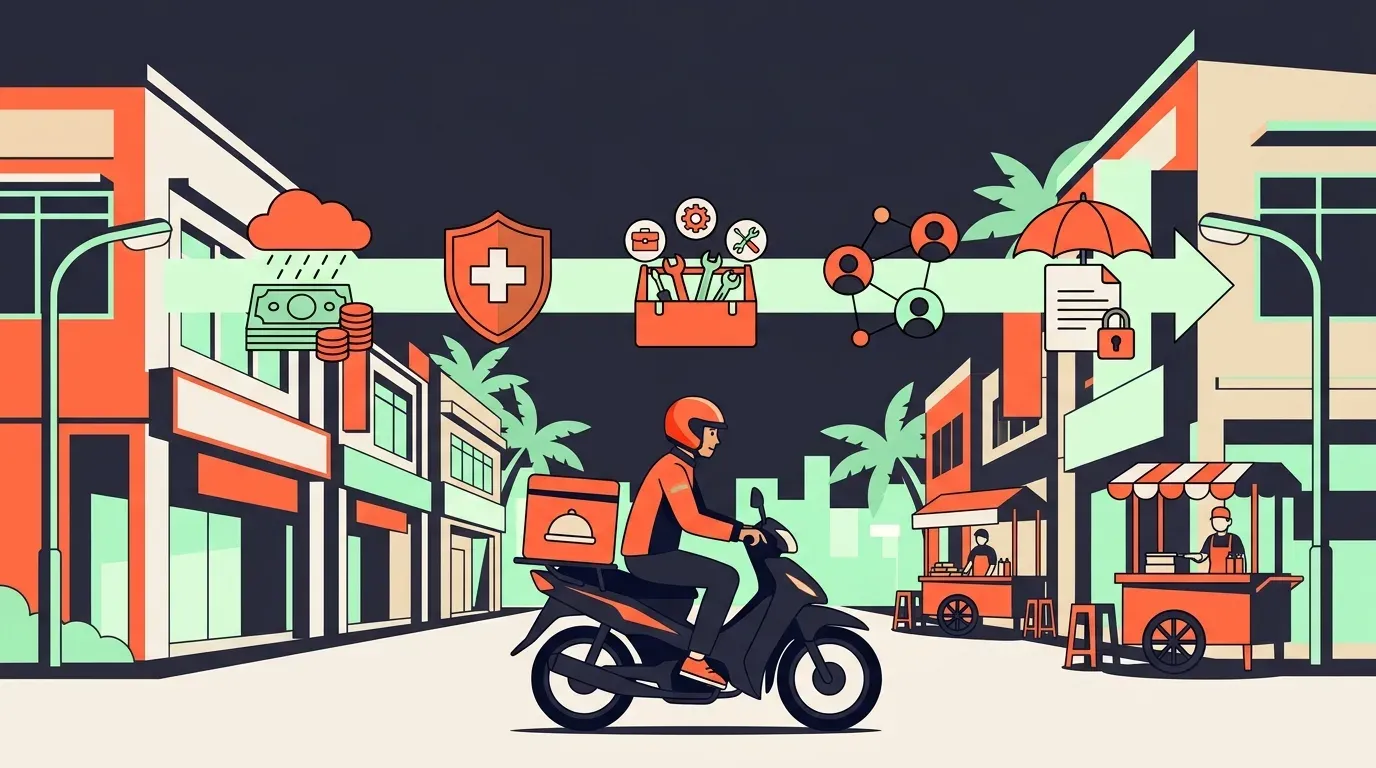
A practical emergency preparedness plan for gig workers: build a cash buffer, stay safe on shift, document your work, and replace lost income fast.
Your Emergency Fund Shouldn’t Wait 30 Days for Payout
Start Here: The 5-Part Emergency Plan Every Gig Worker Needs
It’s 11pm, you’re mopping the last two metres of floor after a closing shift, and your phone buzzes: your roommate’s in the hospital and someone needs to pay the deposit tonight. You’ve worked twelve shifts this month. Every ringgit of it is sitting in someone else’s payroll cycle.
That’s the moment this plan is built for. Here it is, up front:
- Cash you can reach today — not next payday, today.
- A safety kit — small, on you, boring until it isn’t.
- Emergency contacts saved and shared — in your phone and with one person who’d notice you missing.
- A shift-loss backup plan — a way to replace lost income within hours, not weeks.
- Proof of your own work history — shifts, hours, who you worked for.
Screenshot that. The rest of this article is detail.
Why Emergency Preparedness Is Different for Gig Workers
In a salaried job, the system carries some of the risk — paid sick leave, an HR line, a manager who reshuffles the roster. As a gig worker in the gig economy, none of that exists by default, and the broken middleman staffing system is happy to leave it that way: no guaranteed next shift, no one chasing your payment, no paper trail unless you build it.
So you build your own version of each. That’s not pessimism — it’s the same operational thinking a good floor manager uses every service: know what breaks, know your fix, know where the fix lives.
The fifth part — replacing lost income fast — is where payment timing changes the maths entirely. Businesses using FlashJobs pay workers directly when each job ends, so a cancelled job becomes a gap you fill, not a month you absorb.
The Real Emergency Is the 30-Day Wait
The emergency is rarely the thing that happens. It’s the gap between when you need money and when someone else decides to release it.
You’ve already worked the hours. The money exists. It’s just sitting in someone else’s account, waiting for a payout cycle that clears in three weeks. That’s the villain: a staffing system built so your earnings move on the platform’s calendar, not yours.
What waiting actually costs
- Borrowing from friends and family — small amounts, repeated, until people stop picking up.
- High-interest lending apps — a short-term fix that eats next month’s income.
- Skipping the clinic — the cough waits, the tooth waits, the problem gets more expensive.
- Taking the wrong shift — any shift, any distance, because you can’t afford to be selective.
None of that is a money-management failure. It’s what happens when the payment timeline is designed around someone else’s cash flow.
Treat payment speed as a safety feature. Same-day pay means the emergency fund you’re building actually reaches you on the day you need it. So make this your first screening question for any platform, before you ask about rates or locations: “When exactly do I get paid?” If the answer is vague, weekly, or “after processing” — that’s your answer.
FlashJobs was built the other way around: workers get paid same day, for nearby shifts. See how it works.
Build a Cash Buffer That Fits Gig Income
“Six months of expenses” is the advice that stops most gig workers before they start. Begin smaller.
The three-step ladder
- Starter buffer — one week of essentials. Rent share, food, transport, phone. This stops a bad day becoming a bad month.
- Baseline — one month. A slow week or cancelled shift no longer touches your rent.
- Cushion — three months and up. Only after the first two are done. Gig income swings, so this rung takes longer. That’s fine.
Save by the shift, not by the month
Monthly saving assumes monthly income. You don’t have that. Fix a small percentage of every same-day payout — pick a number you won’t argue with yourself about — and move it the same night, before you sleep. Same-day pay is what makes this work: the money you earned at tonight’s dinner rush is already in your hands, so the transfer takes thirty seconds.
Keep the buffer in a separate account — different from your daily spending, reachable at 2am, no penalty for withdrawal. Boring and accessible wins over clever and locked.
This week: work out one week of essentials. Write the number down. Move your first percentage tonight.
Workplace Safety on Shift: Kit, Contacts, Exits
Workplace safety on a short-notice shift starts before service begins. Ten minutes before service at a venue you’ve never worked, a floor manager hands you an apron and points at the pass. That’s your window. Walk the room before you do anything else.
Four things to find before your first shift
- The fire exit — and whether it’s blocked by crates.
- The first aid kit — know where the first aid kit is and who has basic first aid training. It’s usually near the wash station or back office.
- The fire extinguisher and kitchen fire blanket if there’s a fryer.
- The duty manager — a name and a face, so you’re not shouting “someone!” mid-incident.
Occupational safety guidance is consistent: staff should know equipment locations and evacuation routes before an incident, not during one. Ten minutes at the start of a shift is the cheapest insurance you will ever buy.
Your shift kit
- Water bottle — dehydration is how mistakes start.
- Small plaster pack (blue plasters near food).
- Phone power bank — a dead phone is a dead lifeline.
- Non-slip shoes — non-negotiable on tile.
- A written emergency contact in your wallet, not only in your phone. A locked phone helps nobody in an ambulance.
Numbers to save right now
Emergency services (999) — police, ambulance, fire. 991 — Civil Defence (APM). For every venue you work regularly, note the nearest clinic and hospital beside the venue name.
Document Everything: Your Paper Trail Is Protection
A dishwasher slips at 11pm close, ices the ankle, goes home, says nothing. Two weeks later the pay is short and there’s no record the shift happened. No paper, no problem — for the broken system. Your paper trail is how you take that power back.
The two-minute habit
Build one album on your phone called “Work” and drop in:
- Every shift confirmation (venue, date, start time)
- Clock-in and clock-out proof, or a photo of the signed timesheet
- Every payment notification
Keep a running log — date, venue, role, hours worked, pay received. If a payment is disputed six weeks later, you’re showing receipts, not arguing from memory.
Report injuries the same day, in writing
Verbal doesn’t count. If you get hurt — burn, cut, slip, back strain — tell the duty manager and put it in writing the same day: a WhatsApp message, an email, anything with a timestamp. Take photos of the injury and the spot where it happened.
Know your coverage from the official source
Malaysia has social security coverage pathways for self-employed workers through PERKESO (SOCSO), and eligibility depends on your category of work. Check it yourself at perkeso.gov.my — not from a group chat. Hearsay costs people real protection.
Documentation gets you booked faster too
Venues rehire people with a strong record. When your profile shows completed jobs, punctuality, and ratings from real venues, you stop being a stranger and start being someone they can assess using evidence. On FlashJobs, that work record grows with every completed job.
When a Shift Falls Through: Replace the Income Fast
You get the message at 3pm on a Tuesday. The venue is closing for renovation. You were on the roster for four shifts that week. The old system leaves you waiting for someone to call you back. Waiting is the enemy. Replacement is the answer.
Know three to five venues within reach
Proximity is income security. If five venues within a short ride already know your name and that you show up ten minutes early, a lost roster becomes a bad afternoon instead of a bad month.
Keep availability honest and notifications loud
The first person to reply usually gets the shift — that’s how a floor manager thinks when someone hasn’t turned up and service starts in an hour.
- Turn on notifications. Not silent.
- Mark yourself unavailable when you genuinely are. A no-show costs far more than a declined shift.
- Reply fast, even if the answer is no. Speed builds your reputation.
FlashJobs works on the same clock — operators fill a no-show in around 90 minutes, and workers get paid same day for nearby work. When the wait is gone from both sides, a lost shift is replaceable within the same day.
Build skills that travel
Barista basics. POS. Moving from dishwash to floor when the venue is drowning. Every skill that crosses venue types widens your options during a slow week.
Your 72-Hour Preparedness Sprint
You don’t need a month. You need three focused evenings.
Day 1 — Money and numbers (about 45 minutes)
- Open a separate savings account. Different account, no card in your wallet. Friction is the point.
- Pick your per-shift save percentage. Start at 10% of every shift paid.
- Save emergency services (999) and 991 into your phone, plus two personal contacts — one family, one fellow worker who knows your usual venues.
Day 2 — Body and paper trail (about 90 minutes)
- Build the physical kit: plasters, burn gel, painkillers, a spare phone cable, a power bank, cash for a Grab home.
- At each venue you work regularly, walk the exits once. Back door, fire escape, where the extinguisher hangs. Two minutes while the kitchen is quiet.
- Start a shift log album on your phone. Photograph the roster, your clock-in, and anything unsafe.
Day 3 — Income backup (about 30 minutes)
- List venues within 20 minutes of home that use short-notice cover.
- Register on a platform that pays same day — before you need it, not during the emergency. FlashJobs is emergency staffing infrastructure: operators fill a no-show in about 90 minutes, nearby work appears fast, and the business pays you directly when the job ends. Sign up at flashjobsapp.com so it’s already live before you need it.
The weekly habit that keeps it alive
Twenty minutes, once a week: check the buffer balance, confirm your shifts are logged, restock the kit.
The broken system wants your emergency to become debt. Prepared means it stays a bad day — you cover the gap, you get paid, and Monday still belongs to you.
Looking for paid jobs near you? FlashJobs connects you with nearby F&B and hospitality jobs — the business pays you directly and FlashJobs takes no cut. Register early.