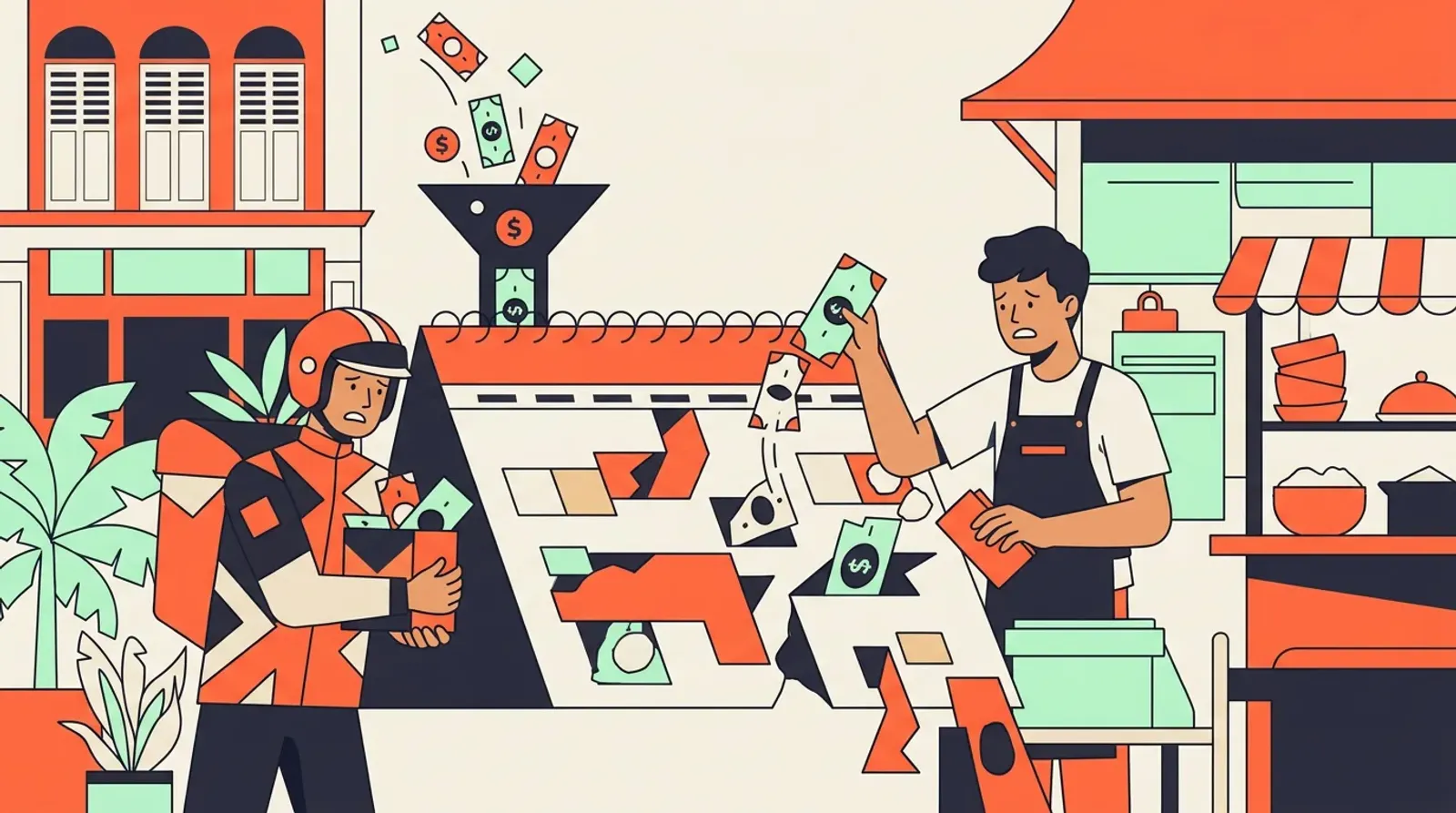
Income instability isn't a personal failing — it's built into delayed pay and opaque platform rules.
Income Instability Isn’t You. It’s the Payout Delay
You Didn’t Cause Your Income Instability. The Payout Calendar Did
Here’s the answer up front: for most shift workers, income instability is a timing problem, not a discipline problem. You worked the hours. The money exists. It just sits somewhere else for two, three, sometimes four weeks — and it arrives in an amount nobody told you in advance.
We’ve sat with F&B crew across Klang Valley who could recite their exact shift count for the month but couldn’t say what would land in their account. That gap isn’t carelessness. That’s a system designed around someone else’s calendar.
Name the real villain
It isn’t your employer. Most outlet managers we work with want people paid fast and hate the paperwork as much as you do. The villain is the machinery in between:
- Wages held on a float, earning interest for someone who didn’t work the shift
- A cut skimmed off the top, described in language nobody reads
- Rules that change without notice, so you can’t plan two weeks ahead
Your annual pay can look perfectly reasonable on paper while every single month feels like a gamble. That’s earnings instability in its truest form — stable totals, unstable weeks.
What you get from this article
A simple way to measure your own income floor, an honest look at what drives month-to-month swings, and three moves that shorten the distance between work done and money in hand — including same-day pay through FlashJobs when a gap day opens up.
What Research Actually Says About Month-to-Month Income Swings
Here is the part nobody tells shift workers: economic research has been documenting this problem for years. Your budget isn’t broken. The timing is.
The instability hides inside the year
Researchers working with JPMorganChase Institute data found that workers’ earnings move considerably from one month to the next — even when annual income and the hourly wage look steady on paper. The yearly average tells a calm story. The months underneath it do not. So when you compare your payslip to your bank balance and feel confused, you’re not bad with money. You’re reading two different clocks.
Unpredictable income costs more than money
The OECD’s On Shaky Ground? report links unstable incomes to economic insecurity: more worry about job loss, thinner savings buffers, and knock-on effects on health and food security. Studies on low income workers show the same double problem — hours swing, then earnings swing. It isn’t only how much you’re paid. It’s how little you can predict.
What this means for your next move
The fix isn’t “earn more one day.” One big payday still leaves a gap week. The fix is making income arrive more often and arrive when promised.
That’s exactly why same-day pay matters. FlashJobs is emergency staffing infrastructure — operators fill a no-show in about 90 minutes, and the worker who covers it gets paid the same day, near where they already are. Shorter gap between work and money. Fewer surprises.
The Three Machines That Keep Shift Workers Unstable
After sitting with hundreds of F&B operators and shift workers across the Klang Valley, we keep seeing the same three machines grinding away. None of them are your fault.
1. The float
You finish the shift. The money doesn’t. Your wage sits in someone else’s account for two, three, sometimes four weeks while rent, petrol and family costs run on a daily clock. That mismatch — not your work ethic — is what creates unstable incomes.
2. The skim
A cut is taken off the top of work you already did. The number advertised on the shift is never the number that lands in your bank. Over a month, that gap quietly decides whether you finish ahead or behind.
3. Opaque gatekeeping and fragmented tools
Hidden ratings. Deactivations with no explanation. Shifts handed out by rules nobody publishes. You cannot plan around a system that won’t show you the rules. Add five apps, five chat groups and five payout dates, and you’re doing unpaid admin work every week.
What breaking the machines looks like
FlashJobs was built as emergency staffing infrastructure, so the fix had to be structural, not cosmetic. Operators fill a no-show in about 90 minutes under a 2-hour SLA. Workers get same-day pay and nearby work — one place, clear terms, money the same day.
Start at flashjobsapp.com and stop financing someone else’s payout calendar.
Measure Your Own Income Floor in 20 Minutes
You can’t fix what you haven’t measured. Sit down with your bank app and a notepad. This takes 20 minutes, and most workers finish it a little angry — in a useful way.
Step 1: Track money received, not shifts worked
Write down the last 8 weeks of money that actually landed in your account, with dates. Then write down what you earned in those weeks. The gap between the two lines is your income instability. It’s a calendar problem, not a character problem.
Step 2: Find your floor
Circle your worst week in that stretch. That number is what your life is currently built on — rent, transport, food for the household. Everything above it feels like luck.
Step 3: Mark your gap days
List the dates each month where money goes out but nothing has landed yet. Rent day. Bill day. School money day. Those are your gap days, and they’re where you need work that pays the same day, not in three weeks.
Step 4: Calculate your true hourly rate
Add travel time, waiting time, and unpaid admin like chasing invoices. A shift 40 minutes each way pays less than the poster says. Divide real pay by real hours committed.
Once you know your floor and your gap days, you can aim at them. FlashJobs exists for exactly that moment: nearby emergency shifts, same-day pay, no waiting for a payout cycle. Run your numbers at flashjobsapp.com.
Fill the Gap Days: Practical Moves That Beat the Float
A gap day is any day the calendar leaves you with no money coming in. You can’t always add more shifts. But you can change which shifts you say yes to, and how fast the money lands.
Choose pay date over promises
Ask one question before you accept: when exactly do I get paid? “Later, probably” and “we’ll sort it next cycle” are not payment policies. Work that pays on the day turns one shift into one solved gap day. That’s the whole trick — same-day pay is why FlashJobs shifts close a gap instead of moving it.
Build a buffer you can’t spend by accident
Send a small, fixed slice of your first same-day payouts into a separate account — no card in your wallet for it. A buffer you can’t tap on a slow Tuesday is the buffer that’s still there when rent lands early.
Keep your own shift log
Date, venue, hours, rate, amount received. Five columns in a notes app. It’s your evidence if a payout goes missing, and your data when you ask for a better rate. Never rely on someone else’s records to prove your own work.
Stack shifts near you
Travel is the silent pay cut in F&B. Two hours of transport for a four-hour shift is a rate cut you agreed to without noticing. Work close, work often.
Start with nearby, same-day shifts at flashjobsapp.com.
How Emergency Staffing Flips the Math in Your Favour
The payout calendar only has power because it controls when money reaches you. Emergency staffing removes that control.
FlashJobs is emergency staffing infrastructure for Malaysian F&B. When a restaurant loses a person mid-service, that shift needs filling in about 90 minutes — not next month. That urgency is your leverage.
Why urgent shifts pay differently
- Real demand, right now. Operators post because service is already short. There’s no waiting queue to sit in while a manager “reviews applications.”
- Nearby work. Shifts show up close to you, so travel and Grab fares don’t eat the pay you just earned.
- Same-day pay, every time. You finish the shift, the money moves the same day. No 30-day float. No cut taken out of your wages.
- Direct match. No intermediary standing between you and the operator. You’re a name on a shift, not a number in a system.
Own your hours, build your floor
Anyone who has worked service knows the real problem isn’t effort — it’s fluctuation you can’t plan around. When you choose shifts that fit your week, the swings shrink. Three predictable shifts you accept on purpose beat five you were promised and never got.
That’s how a floor gets built: shift by shift, paid same-day, on terms you set. Steady income becomes something you construct, not something you hope for.
Start picking up shifts near you at flashjobsapp.com.
Your 7-Day Plan to a Steadier Income Floor
You don’t need a bigger month. You need a floor that stops moving.
Day 1–2: Map what you actually earned
Log your last 8 weeks of pay. Write down every amount and the date it landed. Mark your floor — the lowest week — and circle your gap days. Income volatility stops feeling personal the moment you see it on paper.
Day 3: Audit your pay dates
List every platform or arrangement you work through. Next to each one, write its real pay date — not the promised one. Then drop the slowest. That single cut removes the biggest source of unstable incomes in most shift workers’ weeks.
Day 4–5: Attack your worst gap day
Pick up shifts near you that pay same day, and target your weakest day first. FlashJobs exists because venues need a no-show covered in about 90 minutes — that urgency is why the work is nearby and the pay is same-day. Start at flashjobsapp.com.
Day 6–7: Build the buffer
Move a fixed amount from every same-day payout into a separate account. Small and boring beats big and rare. Keep your shift log running — it’s your proof of income growth over the next few months.
Why this works
You’re not fixing a discipline problem. You’re taking the payout calendar out of a middleman’s hands. When you decide when you get paid, income changes become something you plan for, not something that happens to you.
Looking for paid shifts near you? FlashJobs matches you to nearby F&B and retail shifts — direct wage pay, zero platform fees. Register early.