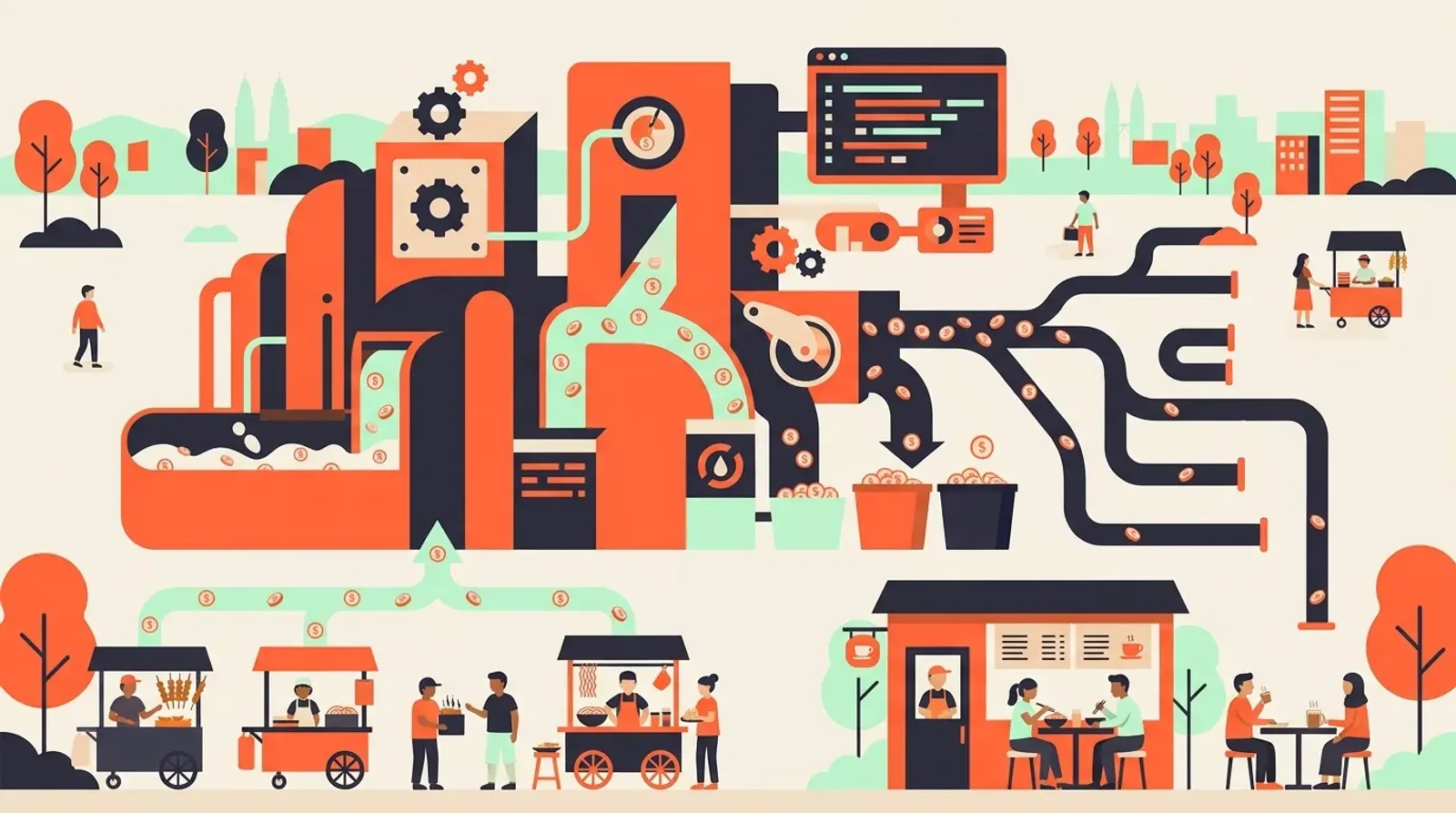
A clear, honest comparison of gig economy and traditional employment to help Malaysian workers choose the right work model for their life.
Gig Economy vs. Traditional Jobs: Know Your Options
The Real Problem Is the System Between You and Your Pay
You clock in. You do the work. Then you wait — sometimes days, sometimes weeks — to see money that was already yours.
That is not an accident. It is the design of a broken middleman system built to sit between workers and the businesses that need them. It takes a cut, delays your pay, and calls you a partner while treating you as a number in a rotation.
The rise of the gig economy has made this choice more visible: flexible shifts or a permanent role, autonomy or stability, same-day pay or a monthly salary. But the work itself is not the enemy. The extractive layer on top of it is.
This article gives you a clear-eyed look at both sides — the real flexibility, the real risks, and the real costs that platforms rarely spell out. Understanding the pros and cons of each model is the starting point for any honest comparison. By the end, you will have a practical framework to decide what structure fits your life right now.
For workers who want flexible F&B shifts without the waiting game, FlashJobs is emergency staffing infrastructure built to cut out the friction — same-day pay, nearby jobs, no middleman holding your earnings.
What These Terms Actually Mean
Gig Work, Plainly Defined
Gig work is short-term, shift-based or project-based work with no long-term commitment from either side. You are typically classified as self-employed or an independent contractor, which means statutory protections do not automatically apply. Workers access these opportunities through digital platforms that match them to shifts or projects — a model that has grown significantly across Malaysia’s F&B and service sectors.
Traditional Employment, Plainly Defined
Full-time work means a formal contract with one employer. In Malaysia, this triggers legal obligations on both sides. Your employer contributes to your EPF (Employees Provident Fund) and SOCSO (Social Security Organisation). You accrue annual leave, sick leave, and public holiday entitlements under the Employment Act 1955.
The Spectrum Nobody Talks About
This is not a binary choice. Many Malaysian workers in the workforce already operate across both models — holding a permanent role while picking up additional shifts to cover rising costs or build savings. The question is rarely which one but how much of each, and on what terms.
Two Persistent Myths
- Gig does not automatically mean freedom. When a platform controls your access to shifts, your rating, and your payout timing, you are dependent on a new kind of middleman.
- Stable work does not automatically mean security. A contract protects you on paper. It does not protect you from stagnant wages or a role that limits your growth.
The Real Trade-Offs: Pros and Cons of Flexibility vs. Stability
What Gig Work Actually Gives You
The appeal is real. You choose your hours. You pick jobs near you. For workers juggling family, studies, or a second income stream, that autonomy has genuine value.
But autonomy is not free. As a gig worker, you absorb the cost of downtime — slow weeks, cancelled shifts, unpaid travel time. You also absorb the absence of:
- EPF contributions — no employer matching your retirement savings
- Paid annual leave and sick leave — every day off is unpaid
- SOCSO protection — workplace injury coverage that full-time employees receive by law
These are structural financial protections that a permanent role builds into your compensation automatically.
What Traditional Work Actually Gives You
Predictable income lands on a fixed date. Your employer contributes to EPF. You accrue leave. You have a defined role with a career path you can negotiate against.
The cost: you trade schedule control for that stability. Your income ceiling is set by a salary band, not by how many shifts you can take. And job security — while real — depends on the health of the business and the terms of your contract, not just your performance.
The Honest Summary
| Gig Work | Full-Time Work | |
|---|---|---|
| Schedule control | High | Low |
| Income predictability | Low | High |
| EPF / SOCSO | Rarely included | Required by law |
| Paid leave | No | Yes |
| Job security | Low | Higher |
| Earnings ceiling | Variable | Structured |
Neither model is broken by design. The broken part is when the system promises flexibility while quietly offloading every financial risk onto you.
What the Broken System Doesn’t Tell You About Gig Pay
The Cut You Never See
Before your pay reaches your account, the middleman takes its share — quietly, before you ever see a figure. You rarely get a clear breakdown. You just receive less than the rate you thought you agreed to.
Payment Delays Are the Norm
Many platforms batch payments on weekly or fortnightly cycles. You finish a Friday night shift and wait until the following week — or longer. If you needed that money for rent or transport, the delay is not a minor inconvenience. It is a real problem.
Tax Is Your Problem Now
Full-time work means your employer handles EPF, SOCSO, and income tax deductions. Gig platforms do not. That responsibility shifts entirely to you the moment you sign up as an independent contractor. Many workers discover this only at year end, when the numbers no longer add up.
Unpredictable Income Is a Feature They Sell as Freedom
Flexibility is real. But it also means shifts disappear without warning, and there is no sick pay, no overtime protection, and no guaranteed hours next week.
FlashJobs was built to cut through exactly this. Workers receive same-day pay after completing a shift — no waiting cycle, no opaque deductions. You worked. You get paid. The same day.
Traditional Jobs: The Stability That Comes With a Cost
Stability is real. A fixed salary, EPF contributions, annual leave, and a consistent schedule matter — especially for workers supporting a family or building long-term financial security.
But stability has a price. In F&B and shift-based industries, that price is often your time.
When you sign a contract in hospitality or food service, you are agreeing to a roster someone else controls. Split shifts, weekend obligations, and last-minute schedule changes are standard — not exceptions. If you are studying part-time, caring for a family member, or running a side income, a rigid schedule can work directly against your work-life balance.
A staff position also offers a career path — supervisor, assistant manager, outlet manager. The ladder is there. But in many F&B operations, promotions move on tenure and relationships as much as on performance. That is not a criticism of employers. It is how hierarchical organisations function. Workers deserve to understand it going in.
The broken part of the old system is not full-time work itself. It is the assumption that every worker fits the same mould. Many do not — and that is exactly the gap that emergency staffing infrastructure like FlashJobs is built to fill.
The Hybrid Model: Why More Workers Are Choosing Both
The gig economy has expanded the options available to workers who want more than one income stream. A traditional anchor job gives you the baseline: fixed income, EPF contributions, and the predictability to plan your life. Flexible work on top smooths out income volatility without chaining you to another rigid schedule.
If you already work in food service or hospitality, you are well-positioned for this model. Shift-based work is the norm in your industry. Your skills are portable — and that experience transfers directly to flexible, on-call work without a steep learning curve.
The hybrid model breaks down when the flexible side stops feeling flexible — when the platform holds your pay for days or weeks. The key is finding flexible work that pays you the same day you earn it.
Make the model work for you:
- Keep your anchor job for stability and benefits
- Take flexible shifts to build savings or cover variable expenses
- Choose platforms that respect your time with fast, fair pay
- Do not overcommit on the flexible side
FlashJobs is built around this reality. Workers access nearby shifts and receive same-day pay, so the flexible side of your income actually behaves like income — not a loan you are waiting to collect.
A Practical Framework: Four Questions to Ask Yourself
1. Do I need income predictability? If rent, loan repayments, or fixed monthly bills depend on a guaranteed number, unpredictable gig economy income is a genuine risk.
2. Do I have dependents relying on my benefits? EPF contributions, SOCSO coverage, and medical benefits matter more when others depend on you. A permanent role provides these by default.
3. Can I handle tax self-management? Gig workers in Malaysia are responsible for declaring their own income. If that feels overwhelming, full-time work removes that burden while you build financial literacy.
4. Do I want schedule control? If rigid hours genuinely limit your life — caregiving, study, a second income stream — flexibility has real value.
Map Your Answers
| Your situation | Recommended structure |
|---|---|
| Need stability, benefits, predictable income | Full-time employment |
| Need flexibility, managing finances well | Full gig or freelance |
| Need both — income floor plus schedule freedom | Hybrid: one anchor role, gig shifts on top |
For F&B, hospitality, and service workers specifically: a permanent role gives you benefits and a base income. Gig shifts on top — through infrastructure that pays same-day and keeps work nearby — let you earn more without sacrificing security. FlashJobs is built specifically for this combination.
The Bottom Line
The gig economy vs. traditional employment debate does not have a single right answer. Both come with real trade-offs.
Full-time work gives you structure, predictability, and legal protections. You trade some freedom for that stability — and for many workers, that is the right call.
Working in the gig economy gives you control over your time. The problem was never the model itself. The problem was the broken system sitting on top of it: delayed pay, opaque deductions, and a middleman that profited from your uncertainty.
Once you understand how the system actually works — who takes what, when you get paid, and what protections you do or do not have — you can make a genuinely informed choice about which work model fits your life right now.
If flexible shifts with same-day pay sound like the right fit for where you are right now, start at flashjobsapp.com.
Looking for paid shifts near you? FlashJobs matches you to nearby F&B and retail shifts — same-day pay, no platform fees. Register now.