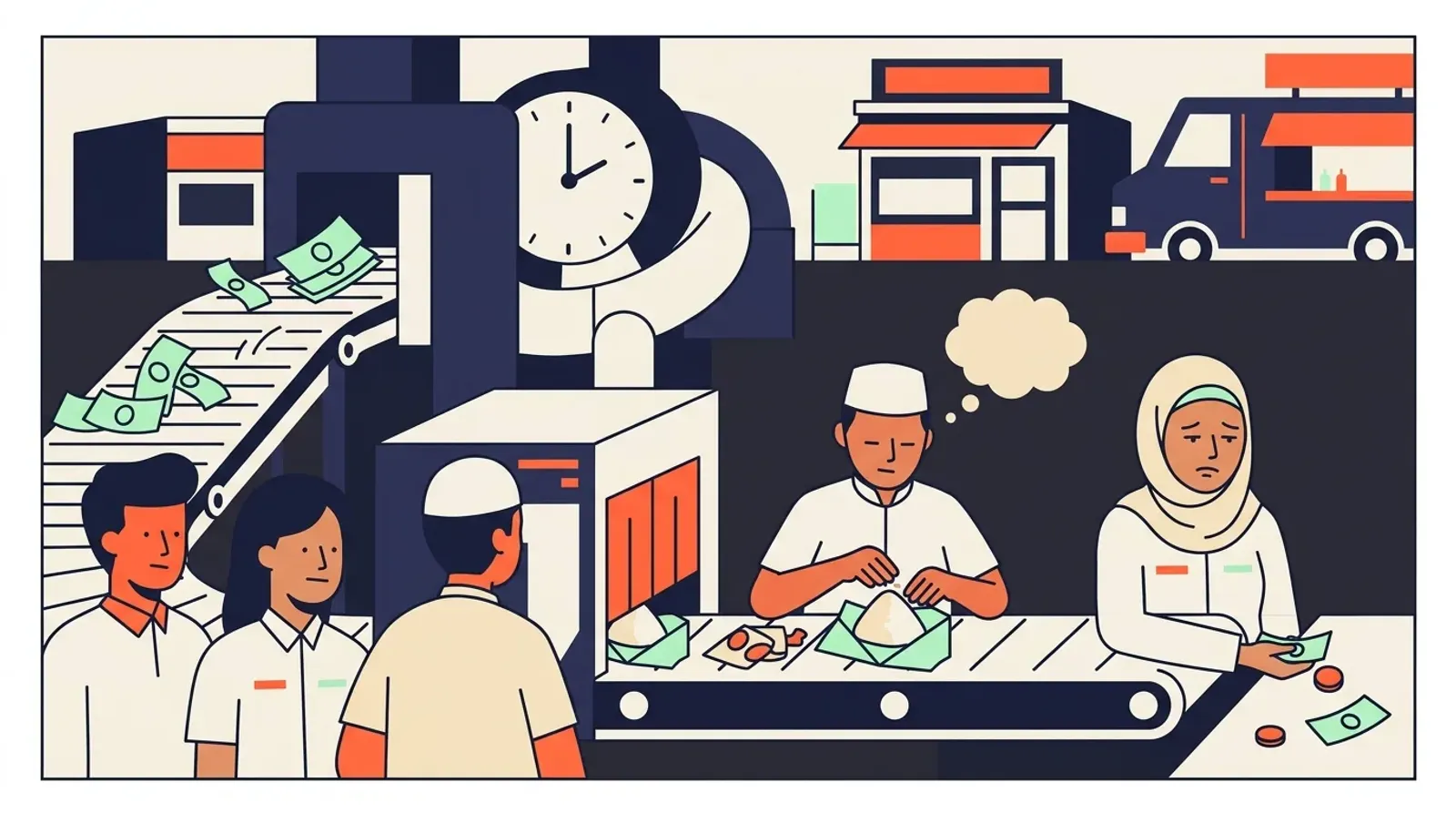
Every shift is a chance to grow. Learn how to turn emergency F&B staffing into real, transferable skills — with same-day pay and no middleman.
Gig Work Keeps You Waiting. Your Skills Don’t Have To
The System That Pays You Last and Teaches You Nothing
You show up. You do the work. Then you wait.
That waiting is not an accident. The traditional middleman staffing system is built around a simple idea: your labour flows up immediately, and your money flows back down slowly. By the time your pay arrives — days later, sometimes weeks — the platform has already made its margin. You carried the risk. Someone else kept the float.
The cut taken before your earnings reach you is not a service fee. It is the cost of a system that positions itself between you and the operator who actually needs you. The longer that chain, the more hands your pay passes through, the less of it lands in yours — and the later it lands.
You Are a Number, Not a Professional
Here is what that system never tells you: it has no reason to help you grow.
When a platform treats workers as interchangeable, your development is irrelevant to its model. It does not matter whether you are getting better at your craft, building speed, or learning to read a busy floor. What matters is that a body fills a slot. Your skills are a means to that end — not something worth investing in.
That framing keeps you replaceable. And replaceable workers do not negotiate. They wait.
The Way Out Starts With You
The good news is that the system’s indifference is also its weakness. Because it never invests in you, every skill you build yourself is yours entirely. No platform can claw it back. No middleman takes a cut of your competence.
Workers who treat every shift as a deliberate skill-building session start to move differently. They accumulate real, transferable capability — the kind that opens doors the old system was designed to keep closed.
That is the real edge. Not waiting for a platform to promote you. Not hoping a middleman notices your reliability. Taking the work that is available, showing up prepared, and walking away sharper than when you arrived.
Tools like FlashJobs exist precisely to cut out the friction — nearby shifts, same-day pay, no unnecessary float. But the skill development? That part is on you. And that is exactly how it should be.
What Skill Development Through Gig Work Actually Means
Most platforms hand you a shift and nothing else. Clock in, clock out, wait for your money. The system was never designed to help you grow — it was designed to fill a slot.
That is the gap worth closing.
Gig Work Is a Live Training Ground — If You Use It That Way
Skill development through gig work means treating every shift as a deliberate learning environment, not just a source of income. The difference between a worker who stagnates and one who compounds their value comes down to one habit: reflection.
Passive exposure looks like this: you show up, you do the task, you leave. You have done the job. You have not necessarily learned from it.
Active skill-building looks different:
- Before the shift — identify one thing you want to do better than last time (speed, communication, station setup).
- During the shift — notice how the team operates, how problems get solved under pressure, how experienced staff carry themselves.
- After the shift — ask yourself one honest question: what would I do differently?
That loop is where real growth happens.
Each Gig Is a New Classroom
Every new employer, venue, and task exposes you to a different set of standards, tools, and expectations. A banquet hall runs differently from a café. A high-volume kitchen demands different instincts than a private event. Moving between these environments forces you to adapt quickly — and adaptation is itself a transferable skill.
Variety is not instability. Handled with intention, it is accelerated experience. The more contexts you work across, the faster your judgment sharpens — because you are not just repeating one system, you are learning what is universal across all of them.
The Honest Caveat
Gig work does not automatically build skills. Fragmented shifts with no continuity, no feedback, and no reflection can leave you treading water. The environment has to support frequency and proximity — enough nearby, regular work that you can actually practice and improve, not just survive.
That is why the structure around your gig work matters as much as the work itself. When you can fill shifts quickly, get paid the same day, and stay close to familiar venues, the learning cycle closes faster.
The broken system wants you reactive. Skill development makes you deliberate.
The Hard Skills Gig Work Forces You to Build Fast
Most workers spend years in one kitchen, one café, one front-of-house setup. You might spend that same time working across a dozen different ones. That gap in experience is not a disadvantage. It is a compressed education.
You Learn the Trade by Doing It Repeatedly, Under Pressure
Every shift in a new F&B environment throws a different set of demands at you. One venue runs a full barista bar with manual espresso workflow. The next uses a high-volume POS system you have never touched. The one after that expects you to handle kitchen prep from cold storage to pass in under fifteen minutes.
Each unfamiliar setup forces you to adapt quickly, ask the right questions, and perform before you feel fully ready. That is not stress for no reason. That is how hard skills actually form — through repetition across varied contexts, not through reading a manual once.
The Digital Layer Is Now Part of the Job
Modern shift work is not just physical. You are navigating booking apps, confirming schedules, reading shift briefs, and tracking your own hours and earnings. Workers who treat this as an annoyance fall behind. Workers who treat it as a skill set pull ahead.
Understanding how to read shift data, manage your availability clearly, and communicate through digital channels makes you faster to deploy and easier to trust. Operators notice this immediately.
Time Management That Actually Means Something
Classroom time management is theoretical. Real time management is a lunch rush with two staff down and a full floor to cover. Gig work puts you in those moments regularly.
You learn to prioritise tasks without being told. You learn where the bottlenecks are before they become crises. You learn that showing up ready — mentally and physically — is a skill that compounds every single shift.
New Environments Accelerate What a Fixed Job Cannot
A fixed role teaches you one system deeply. That has value. But rotating across environments teaches you to transfer skills fast, identify what is universal, and build confidence in unfamiliar rooms.
FlashJobs is built for emergency staffing — the shifts are real, live, and high-pressure because a business needs someone now, not next week. Every shift you take adds to your range, and the steep learning curve is short and repeatable.
That is a harder skill set than most fixed roles will ever give you.
The Soft Skills Nobody Talks About (But Employers Notice)
Hard skills get you through the door. Soft skills determine whether you get called back.
The broken staffing system never invests in this. It processes you — assigns a shift, collects its cut, moves on. There is no feedback loop, no coaching, no recognition that you just did something genuinely difficult. So the skills you build go unacknowledged, even as they quietly compound.
Here is what actually develops when you work gig shifts regularly.
Adaptability You Can Feel
Walking into an unfamiliar kitchen, bar, or event floor with thirty minutes before service starts is a pressure test most people never face. You do not know where the ice machine is. You do not know the head chef’s communication style. You figure it out fast, or the shift falls apart.
Do this enough times and adaptability stops being a personality trait. It becomes a practiced skill — the ability to orient quickly, identify who to listen to, and contribute before anyone has to ask.
Reading a Room Without a Handbook
Every workplace has unwritten rules. Experienced gig workers learn to read them in minutes: who leads, what the pace expectation is, where the tension sits. No onboarding deck teaches this. Repeated exposure does.
FlashJobs is emergency staffing infrastructure — a business facing a no-show, a team already under pressure, a shift that needs someone who can perform from minute one. Workers who thrive here are developing a skill that full-time employees rarely need to sharpen.
Professionalism Under Ambiguity
No manager briefing. No welcome lunch. Just: here is the station, service starts soon.
Delivering calmly under those conditions signals something employers notice immediately — self-direction, composure, and accountability without supervision. These are qualities that transfer directly to permanent roles, promotions, and leadership tracks.
The Compounding Effect
Each gig adds a data point. A different venue, a different team dynamic, a different pressure point. Over time, you are not just collecting shifts — you are building a genuine competitive edge that most candidates cannot replicate in a single workplace.
The system never told you this was happening. Now you know. Use it deliberately.
Why Fragmented Gig Work Can Fragment Your Growth Too
Here is the part most gig platforms will not tell you.
Jumping between unconnected shifts — different venues, different teams, different expectations every week — can quietly stall your growth. Not because the work is bad. Because there is no feedback loop.
When the System Keeps You in the Dark
The broken middleman model runs on opacity. You accept a booking, you show up, you finish. Then nothing. No debrief. No rating explanation. No honest signal about what went well or what to sharpen.
Worse, when a booking disappears or a repeat invite never comes, you rarely know why. Opaque platform rules leave you guessing. Was it your performance? A venue preference? An algorithm? That uncertainty is not just frustrating — it actively blocks improvement. You cannot fix what you cannot see.
No Continuity Means No Ladder
Skill development needs repetition with reflection. When every shift is a one-off transaction at a random location with strangers you will never see again, three things disappear:
- Mentorship — no senior colleague watches you work and offers a better technique
- Progression — no one notices you are ready for more responsibility
- Feedback — no structured moment to learn what you actually did well
The result? You stay busy but plateau. The hours accumulate; the skills do not.
The Fix Is Intentional, Not Automatic
The system will not build this structure for you. You have to build it yourself.
Start by treating every shift as a deliberate practice session. Before you walk in, pick one skill to focus on — speed on a particular station, handling a difficult customer interaction, or managing your setup time. After you finish, spend five minutes reviewing it honestly. That small habit turns a transaction into a training rep.
Working the same area consistently also helps. When you return to familiar venues, supervisors remember you, spot your progress, and offer real feedback. Proximity creates continuity. Continuity creates growth.
FlashJobs connects workers to nearby shifts with same-day pay, so the barrier to taking the next shift drops significantly. More shifts, closer to home, with money in your account the same day — that removes the friction that stops most gig workers from building any momentum at all.
The fragmentation is real. But it is not inevitable.
How Nearby, Frequent Work Compounds Your Skill Set
Skill development is not a single event. It is a process built through repetition, pressure, and variety — all stacked close together. Two factors accelerate that process more than any course or certification: proximity and frequency.
Proximity Gives You Energy to Actually Learn
A two-hour commute to a shift drains you before you even clock in. When you arrive exhausted, you execute the minimum and leave. Nothing compounds.
Nearby work changes that equation. When the venue is close, you arrive with energy to spare. You notice more. You ask better questions. You take on harder tasks instead of just surviving the shift. Over time, that extra bandwidth is where real skill growth lives.
Frequency Turns Exposure Into Mastery
One shift in a busy kitchen teaches you something. Ten shifts across five different kitchens in a month teaches you how to adapt — the true marker of an experienced operator.
Repetition across varied environments is what separates someone who has done a job from someone who genuinely knows it. Each new venue has different equipment, different service rhythms, different standards. Navigating that variation sharpens your judgment in ways a single steady placement never will.
High-Pressure Environments Are the Best Classroom
The broken system sends workers to dead shifts or keeps them waiting on an app for work that never arrives. That is wasted time and wasted potential.
FlashJobs is built for emergency staffing — the shifts are real, live, and high-pressure because a business needs someone now, not next week. A restaurant scrambling to fill a no-show does not need a warm body — it needs someone who can perform immediately. Rising to that standard, repeatedly, is the fastest professional development available in the F&B industry. Workers also receive same-day pay, so the barrier to taking the next shift stays low.
The Compound Effect in Practice
- Nearby work → more energy → better performance → faster learning
- Frequent shifts → more repetitions → stronger adaptability → sharper skills
- Same-day pay → less financial anxiety → more focus on the work itself
Stack those three together consistently, and your skill set grows shift by shift — not someday, but now.
Building a Skill Portfolio That Outlasts Any Single Platform
The broken system wants you to stay anonymous — a profile number shuffled by an algorithm, replaceable the moment a platform updates its rules. Your skill portfolio is how you fight back. It belongs to you. No algorithm change, no platform shutdown, no sudden policy update can take it away.
Start With a Running List
You do not need a fancy app. A notes file on your phone works. After every shift, add three things:
- The environment — café, hotel banquet, food hall, high-volume event
- The tasks — table service, barista bar, prep kitchen, cashier
- The tools or systems — POS software, coffee equipment, service styles
Over weeks, this list becomes evidence. It shows you — and any operator — exactly what you have handled and where you are growing.
Diversify Deliberately, Not Accidentally
Taking random shifts just to fill your calendar is income diversification. That is fine. But skill diversification requires intention. Look at your list and ask: what environments am I missing? If you have only worked casual dining, target a hotel banquet shift. If you have never run a high-volume bar, find one.
Each new environment adds a skill layer that a single long-term role rarely offers.
Build a Niche That Commands Better Rates
Breadth opens doors. Depth gets you paid more. Workers who develop genuine niche expertise — high-volume event service, specialty coffee, fine dining floor management — become the operators’ first call, not their fallback option. Niche expertise is not just about technique. It is about knowing the pace, the pressure, and the standards of a specific environment well enough to perform without hand-holding.
That reputation travels faster than any platform ranking.
Your Portfolio Is Portable
Platforms come and go. Algorithms shift. What you have genuinely learned — how to read a busy floor, manage a service station under pressure, operate unfamiliar equipment with confidence — moves with you everywhere.
Workers who treat each shift as a skill-building session compound their value over time. FlashJobs connects you to nearby, frequent work across real F&B environments, so that compounding happens faster. Every shift logged at flashjobsapp.com is another line in a portfolio no system can delete.
Managing Money So Your Skills Have Room to Grow
Financial instability is the single biggest reason gig workers stop investing in themselves. When you are waiting days — sometimes weeks — for pay to clear, every small decision becomes a survival calculation. Do you buy the knife roll that makes you faster? Do you sign up for the food safety certification course? You cannot think about growth when you are managing a cash gap.
That is the broken system at work. Delayed pay is not just an inconvenience. It is a trap that keeps your attention locked on this week’s bills instead of next month’s skills.
The Float Problem Nobody Warns You About
Float anxiety is real. It is the low-level stress of knowing money is owed to you but not yet available. Workers in this position often make decisions they would not otherwise make — skipping a course, passing on a tool, or taking a poorly matched shift just to cover a gap. None of those choices move your career forward.
Same-day pay changes the equation. When your earnings land the same day you work, you are no longer managing a float. You are managing actual cash. That is a fundamentally different mental state — and a much better one for making smart decisions.
Cash in Hand, Skills on the Table
With same-day pay, the reinvestment window opens immediately. A certification fee does not have to wait until next Friday. A pair of non-slip shoes that keeps you safe and fast does not require a bridge loan from your savings.
Small, consistent reinvestments compound over time. A food hygiene certificate, a barista course, a better set of tools — each one raises your value for the next shift and the one after that.
Stable Cash Flow Is the Foundation
No skill development plan survives chronic financial instability. Consistency matters. Workers who know they will be paid the same day they work can plan with confidence — budgeting for courses, setting aside money for equipment, and showing up to each shift without the distraction of unpaid earnings hanging over them.
FlashJobs pays workers the same day, every time. That is not a perk. It is the financial foundation that gives your skills room to grow.
Start building that foundation at flashjobsapp.com.
Your Next Shift Is a Skill-Building Session — Here’s How to Start
The old system kept you waiting — waiting for pay, waiting for shifts, waiting for someone to notice your progress. You already beat that system by showing up. Now make every shift count twice: once for the income, once for the skill.
It does not take a training programme. It takes a small, repeatable habit.
The Two-Step Shift Practice
Before each shift, pick one skill to focus on. Just one. It could be:
- Plating speed at a busy station
- Handling a difficult table without escalating
- Learning how a new kitchen organises its prep flow
- Communicating clearly with a floor manager under pressure
After the shift, write one sentence about what happened with that skill. Not an essay. One honest observation. Over weeks, those sentences become a record of real growth that no certificate can replicate.
Use Nearby Work to Build Deliberately
Fragmented shifts at distant venues drain your energy before you even start. When work is close to home, you arrive sharper and leave with capacity to reflect — not just recover.
FlashJobs is built for emergency staffing — the shifts are real, live, and high-pressure because a business needs someone now, not next week. That means every shift you take is a genuine test: a quieter café shift to sharpen your customer communication, or a high-volume event to test your speed under real pressure. You are not filling a roster — you are stepping into a live environment that demands your best from minute one.
Same-Day Pay Removes the Financial Barrier to Practice
One of the quieter ways the broken system stunts growth: when pay is delayed, you cannot afford to take the shifts that would teach you the most. You chase volume out of necessity, not strategy.
FlashJobs pays the same day. That single change means you can take more shifts, more often, without gambling on your cash flow. More shifts, done intentionally, compound faster than any course.
Start Now
You do not need a perfect plan. You need the next shift and a reason to pay attention during it.
Visit flashjobsapp.com to find nearby F&B shifts that fit your schedule and your current skill level. Show up ready to earn. Leave ready to grow. The system that kept you waiting is already behind you.
Looking for paid shifts near you? FlashJobs connects you to nearby F&B and retail shifts — direct same-day pay, zero platform fees. Register now.