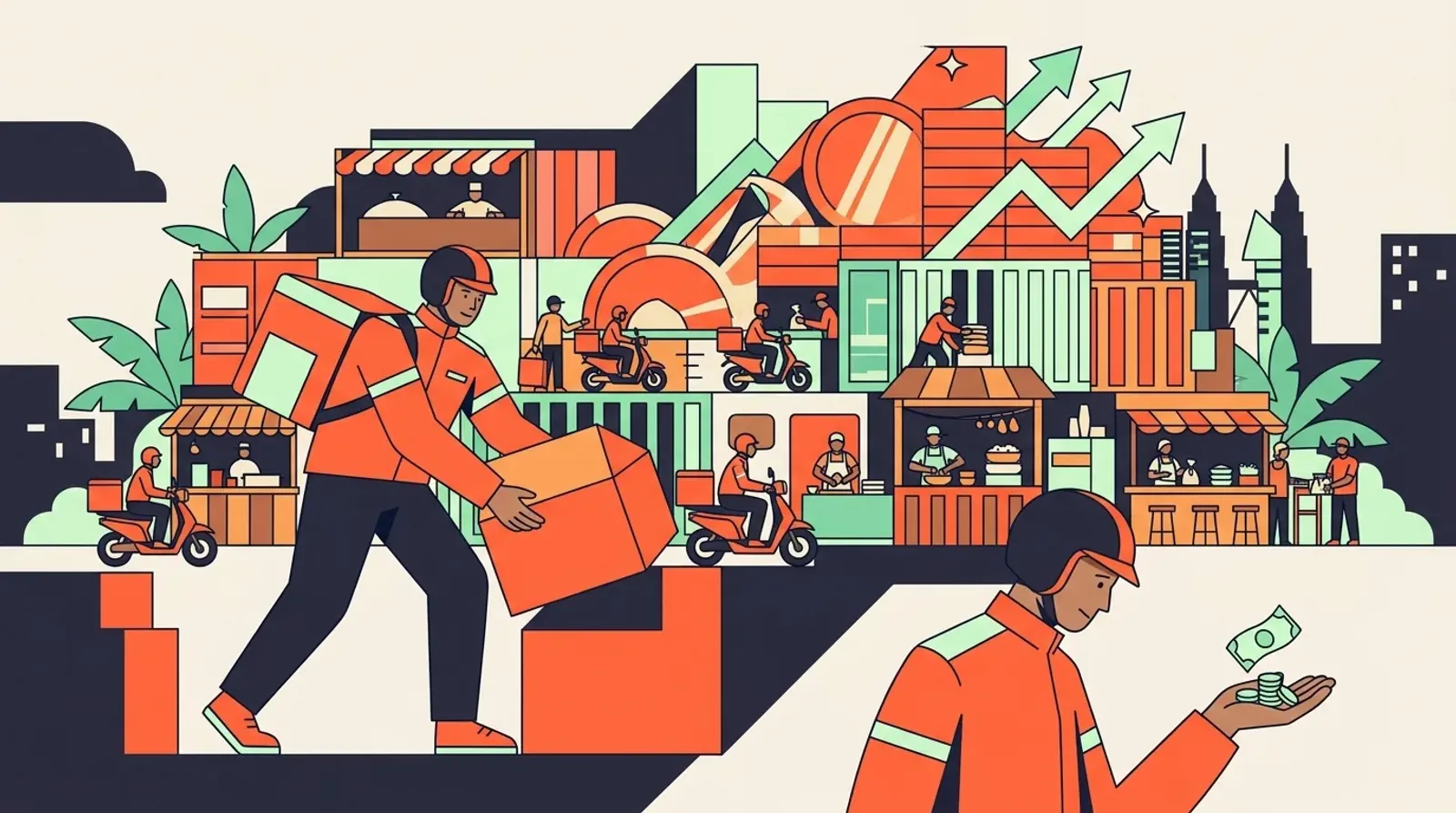
The global gig economy is broken by design — delayed pay, opaque rules, and AI-driven scoring. Here is what fair emergency staffing infrastructure looks like.
Why Emergency Staffing Infrastructure Beats the Broken Gig Economy
You showed up. You covered the shift nobody else wanted. You kept the kitchen running when everything else fell apart.
The gig economy is enormous. You helped build it. But when it came time to split the value, the system took its cut first — and you got what was left, days later.
This article is a map, not a complaint. It covers what the gig economy actually is, why its payment model is broken by design, and what emergency staffing infrastructure looks like when it is built around the worker instead of the middleman.
What the Gig Economy Actually Is
The gig economy is short-term, task-based work matched between workers and businesses through a digital platform. You get a job. You do it. The system takes a cut. The engagement ends.
No ongoing relationship. No guaranteed hours. No safety net built in by default.
Today the gig workforce spans hundreds of millions of workers across the global labour market — from food delivery riders in Southeast Asia to rideshare drivers in the United States — making it one of the most significant shifts in how work is organised globally.
Gig work is not the same as:
- Freelancing — Freelancers market their own skills, negotiate their own rates, and build client relationships. Gig workers accept pre-set terms set by the system.
- Part-time work — Part-time workers have a contract and legal protections tied to an employer. Gig workers generally have neither.
- Casual labour — Casual work still flows through a known employer. Gig work routes everything through a digital intermediary that classifies itself as a technology company, not an employer.
That classification gap is not just semantic. It determines what protections you have — and for most gig workers, the answer is fewer than the onboarding screen suggests.
The System Was Built for the Platform, Not for You
You finish a shift. Then you wait. That gap between finishing work and seeing money in your account is not an accident. It is a design choice made for the middleman’s benefit.
The Float Is Not Your Friend
When these companies hold your earnings for 14, 21, or 30 days, that cash sits in their account. At scale, across hundreds of thousands of workers, that payment float is a meaningful financial asset. You are effectively lending money to a business that already charges you for the privilege of finding work.
You Are a Number in a Dashboard
These companies take a cut from every booking — then hand you a rating. A score out of five, generated by AI-driven scoring systems that can quietly push you down the algorithm with no explanation and no appeal. You are not a worker to these systems. You are a data point with a cost attached. Artificial intelligence optimises the matching engine for the platform’s margin, not your livelihood.
Lock-In Protects the Middleman
Prepaid credit bundles and subscription tiers look like convenience. They are loyalty traps. Operators commit budget upfront, workers stay dependent on the system’s ecosystem, and the middleman collects regardless of whether the match was good or the shift was filled.
The risk stays with you. The margin stays with them.
What F&B Workers Actually Experience
If you have ever worked a banquet shift, a weekend brunch rush, or a pop-up event, you know the pattern. You get a call the night before — sometimes the morning of. You show up, you work hard, and then you wait. Days for confirmation. Weeks for payment.
F&B and hospitality workers are the engine of the industry. Without them, restaurants go dark during peak hours, events collapse, and hotel banquets grind to a halt. Yet this segment remains the most underserved in the entire gig economy.
The broken pattern most workers know too well:
- Shifts confirmed at the last minute — or cancelled just as late, with no compensation
- No guaranteed hours, so you cannot plan your week or your income
- Pay held for days or weeks after you have already done the work
- No visibility into nearby jobs, so you burn time and money just getting to the venue
You are treated as a number to fill a slot. When the slot is gone, so is any obligation to you.
The Flexibility Trap
The pitch is always the same: freedom, flexibility, be your own boss. The autonomy is real — you can log on at noon, take a shift near home, or step back when life gets complicated. For workers with caregiving responsibilities, students, or those building side income, that control matters.
But many gig workers did not choose this model. The World Economic Forum and the International Labour Organization have both documented the growth of non-standard work globally, noting that workers often enter gig arrangements not by preference but because traditional work is inaccessible — due to geography, credentials, or economic pressure. Choice and necessity are not the same thing. The system blurs that line on purpose.
Global Trends That Matter for Workers
Regulation Is Catching Up
The legal floor is rising. The EU’s Platform Work Directive, formally adopted in 2024, creates a legal presumption of employment for platform workers across EU member states (European Parliament, 2024). The UK Supreme Court’s 2021 ruling in Uber BV v Aslam established that drivers were workers entitled to minimum wage and holiday pay (UK Supreme Court, 2021).
Malaysia is watching. These rulings set precedents that travel. These companies that treat workers as disposable are increasingly exposed.
Specialist Platforms Are Winning
Generalist platforms promised everything and delivered average. Sector-specific infrastructure — built around F&B, logistics, healthcare — understands the actual job. It vets for relevant skills, matches shifts that make sense, and reduces noise. For workers, specialisation means better fit and faster placement.
Same-Day Pay Is Now the Baseline
Workers won the payment speed argument. Same-day and instant pay are no longer a selling point — they are the minimum expectation. Any system still making you wait days or weeks for money you already earned is running an outdated model at your expense.
What Emergency Staffing Infrastructure Changes
FlashJobs is not a gig marketplace. It is emergency staffing infrastructure built specifically for F&B and businesses in Malaysia — designed to break the broken middleman pattern, not add another layer to it.
The difference is concrete:
- Same-day pay. You work the shift, you get paid that day. No chasing, no waiting.
- Nearby work. Jobs matched to your location mean less commute and more take-home.
- Fast fill for operators. Operators fill a no-show in roughly 90 minutes, with a two-hour service commitment.
That speed only works because workers can trust the system enough to show up ready. When workers are paid fairly and fast, everyone on the floor performs better. The venue wins. The worker wins. The broken middleman loses.
Same-day pay is not a perk bolted on as a bonus. It is proof that holding your money was always a choice, not a necessity.
A Checklist: What Good Work Actually Looks Like
The broken system has trained workers to accept bad deals quietly. Here is the standard you should hold any platform to.
Transparent pay before you accept. You should see the exact rate before you commit to a shift. Not an estimate. Not a range. The number. If the system hides the rate until after you accept, that is a trap.
Same-day pay as standard. Waiting days for money you already earned is a feature of the old system. Same-day payment should be the baseline, not a premium perk.
Work that is actually near you. A 90-minute commute for a 4-hour shift is a net loss. Real nearby work means the match is within a reasonable distance so the job makes financial sense before you leave the house.
No hidden cuts. Honest infrastructure shows you what you take home, not what sounds good in a headline.
Clear terms with no lock-in. You should not need to prepay for access, commit to a monthly bundle, or jump through hoops to withdraw your own earnings.
Stop Waiting for the System to Fix Itself
The broken middleman economy will not fix itself. Systems built on extracting value from your labour have no incentive to share more of it.
Choosing where you work is power. Every time you pick infrastructure that respects your time, pays you the same day, and puts work close to where you already are, you are making a decision the old system cannot survive.
If you work in F&B or hospitality in Malaysia, the old way looks like this: you pick up a shift, you work it, you wait days or weeks to see your money. You are last to know about changes. You are first to be cut.
FlashJobs was built against that model — emergency staffing infrastructure designed around the worker as much as the operator. Same-day pay. Work near you. Shifts that fit your schedule.
See how FlashJobs works at flashjobsapp.com
Looking for paid shifts near you? FlashJobs matches you to nearby F&B and retail shifts — same-day pay, work near you. Register now.